
U.N. to vote to adopt new, more accurate world map
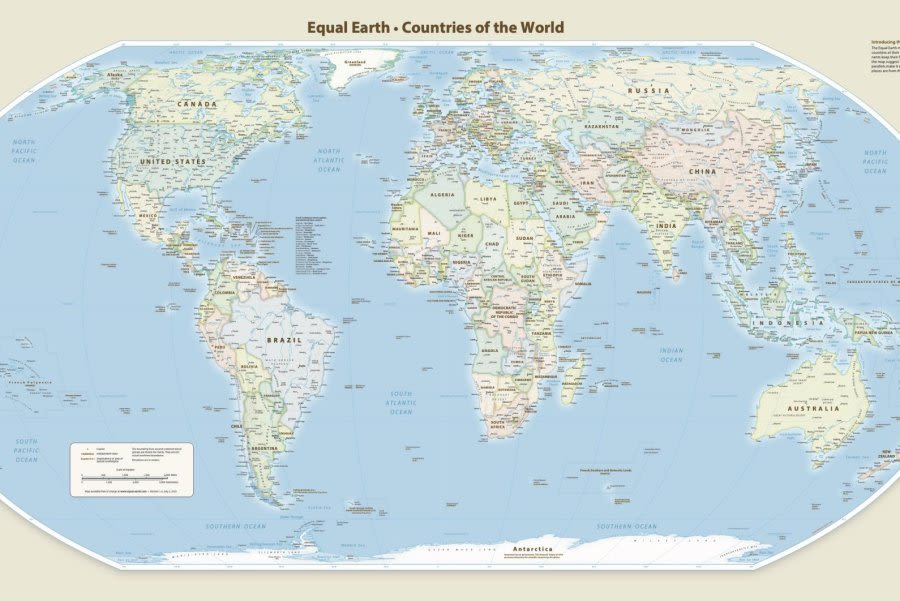
Sept. 4 (UPI) -- The United Nations will vote Friday to adopt a new map of the world meant to make the countries appear more true to size than they are on the one we use today.
The 2018 equal Earth design was developed by an international team of cartographers to replace the use of the Mercator map that we use today. Because the Earth is round and maps are flat, drawing countries and continents true to size is difficult, and the size of some countries gets distorted in the process.
Supporters of the equal Earth map have said the Mercator map that has been used for centuries has created a historical bias that has minimized tropical and equatorial regions and exaggerated the size of countries near the poles, often the wealthiest countries.
If the U.N. adopts the resolution, it wouldn't require the use of the equal Earth map. The idea is to raise awareness of the effects of distorted images and how it affects the way people view the world.
The Mercator map was designed by Flemish cartographer Gerardus Mercator in 1569 to help sailors navigate the seas. But it distorts sizes. For example, it makes Greenland look as big as Africa, though it's only a portion of the size. It also makes Alaska look bigger than Mexico, when it isn't.
Countries in Africa have advocated for the equal Earth map's use because it changes perceptions of African nations. Togo introduced the resolution to the U.N.
"A map is never neutral," Robert Dussey, foreign minister of Togo, said on Thursday, promoting the U.N. resolution. "It shapes perceptions, influences how the place of peoples and continents in the world is understood and may, sometimes from the earliest years of schooling, perpetuate representations that do not correspond to geographic reality."
Togo's government is planning an event in its capital Lomé with UNESCO, the African Union and tech brands such as Google Maps, early next year to plan the resolution's implementation.
"To those who say why now, I say, why not? When we look at the world map ... it is time for us to change the narrative," Dussey said. "It's time for us in Africa to take responsibility to change what we can change ourselves."
Related Stories
 World
World
Ultimate field stars to watch
49 minutes ago
 World
World
2 trapped workers rescued from hydropower tunnel 9 days after Nepal floods
1 hour ago
 World
World
Germany's AFD could become 1st far
1 hour ago
 World
World
US diesel prices hit an all-time
1 hour ago
 World
World
Genetically modified pig kidney keeps man alive for record nine months
2 hours ago
 World
World
Body of world's youngest traditional king returns home to Uganda amid succession row
2 hours ago
 World
World
Price of diesel hits all
2 hours ago
 World
World
WNBA news: League posts historic FIBA Women's World Cup participation
4 hours ago