
1.2M British Columbians have no family doctor
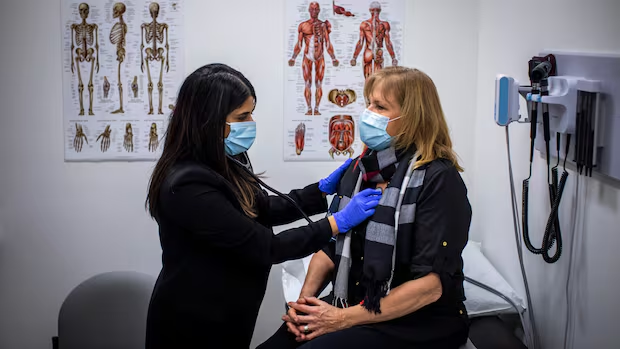
1.2M British Columbians have no family doctor — even as B.C. NDP touts successes
Provincial changes have brought more physicians to B.C., so why is getting a family doctor still so hard?
As B.C. NDP Leader David Eby makes his pitch for re-election to British Columbians, his party's record on health care has quickly become a theme of campaign stops.
"We have connected a million people to a family doctor," he told reporters gathered for the announcement of a snap election on Tuesday.
"This isn't just a trade war. This is about whether your family can see a doctor when you need one."
Solving B.C.'s family doctor shortage was a key promise in the NDP's 2024 election platform — and one they seemed confident they'd keep.
"With this pace, everyone who wants a family doctor or nurse practitioner gets one by the end of 2025," reads the election platform.
So where does the province stand two years later?
In a statement to CBC News provided hours before Eby made his election announcement on Tuesday, the Health Ministry said that since 2018, "over 895,000 British Columbians have been newly attached to a primary care provider. An attachment update will be provided soon."
During election periods, provincial ministries enter caretaker mode, so a spokesperson said no update will be coming.
But an April 2026 exchange from the Legislature provides the most recent glimpse of how many B.C. residents don't have a doctor.
Josie Osborne, speaking as the minister of health, told legislators that "the most up-to-date information we have shows there are now 1,259,425 people not attached."
"When looking at the population and the attachment rate, we see 77.8 per cent to a primary care provider across the province."
The problem isn't unique to B.C. — across Canada, nearly six million people don't have a family doctor, according to a December 2025 estimate.
Some on the frontlines say a number of changes brought in by the NDP government have been game-changing.
The province implemented a new payment model as an alternative to the older fee-for-service system, and streamlined the process for internationally trained physicians to work in B.C.
It also launched the Health Connect Registry, an online portal linking patients to care providers.
Has it become easier to find a family doctor in B.C?
Birinder Narang, president of B.C. Family Doctors, said investments by the province have fundamentally changed family practices in B.C., despite ongoing challenges.
"It's easy to look at it as a black and white issue, but there are complexities we have to deal with," he said.
"Compared to three years ago, definitely there is more life, viability, sustainability within community family practice models. I see new clinics being opened, I see new people coming in to communities, which is very exciting."
There are some standout successes.
Data from the North Shore Division of Family Practice reveals doctors in the region currently have capacity to take on 20,000 new patients.
That hasn't been the story everywhere.
Narang said challenges remain acute in some regions of the province, including the north and the Interior. In some cases, population growth and physician retirements have outpaced progress.
After years of family doctor shortages, the North Shore has room for 20,000 new patients
'I'm a problem solver': Meet the mayor whose plan to attract family doctors is turning heads across Canada
Aaron Childs, a family physician and board member with the Victoria Division of Family Practice, said on Vancouver Island, where the population skews older than the rest of the province, it's a challenge to meet the demand for care.
"My colleagues who are now at retirement age are closing their practices, and so even though we're bringing on new physicians and nurse practitioners, it's still a challenge to bridge that gap," he said.
Childs said the process to recruit a physician to B.C. can take up to a year, meaning there's a lag between policy and results.
"A lot of these investments and changes, they are starting to show results, but it does take some time, unfortunately," he said.
400 doctors, nurses have relocated from U.S. to B.C. in last year
In the update provided by the ministry prior to the election period, the province said B.C. now has the highest numbers of doctors per capita in Canada.
According to the ministry, in 2025 alone over 225,000 people were newly attached to a primary care provider — the highest since the ministry started tracking attachment rates.
Provinces are turning to U.S. health-care workers to help with shortages. And it’s working
More Canadians have a family doctor, but 'concerning gaps' found
Since the start of this election campaign, Eby has vowed to triple U.S. health worker recruitment.
Narang said he hopes any party who forms government will commit to ensuring all B.C. residents have access to primary care.
"We are making progress but we're not where we need to be," he said.
"We need to keep working with whatever government comes into power to make sure we're moving forward in this, and not taking any steps backward."
Michelle Ghoussoub is a reporter and anchor for CBC News based in Vancouver. She has received two nominations for the Canadian Screen Award for best local reporter and won an RTDNA for investigative excellence. She can be reached at michelle.ghoussoub@cbc.ca.
Related Stories
 Canada
Danielle Smith’s popularity dips as her party now tied with NDP in support: poll
54 minutes ago
 Canada
Vietnam's leader To Lam visits Ottawa as Carney reaches out to middle powers
54 minutes ago
 Canada
Highrise tenants want action amid slow repairs to Canada Day flood damage
54 minutes ago
 Canada
Canada’s politeness problem: How to stop playing nice and assert itself more
1 hour ago
 Canada
DEAR ABBY: Self
1 hour ago
 Canada
Michael Higgins: Canada's unimaginative media can't get enough of these academics
2 hours ago
 Canada
Cheap Leafs aren't the only big news coming from Nissan Canada
2 hours ago
 Canada
As referendum looms, 70% of Albertans want province to remain in Canada
2 hours ago