
Artificial Intelligence, Adaptive Radiotherapy and Treatment Automation Transform Global Cancer Care
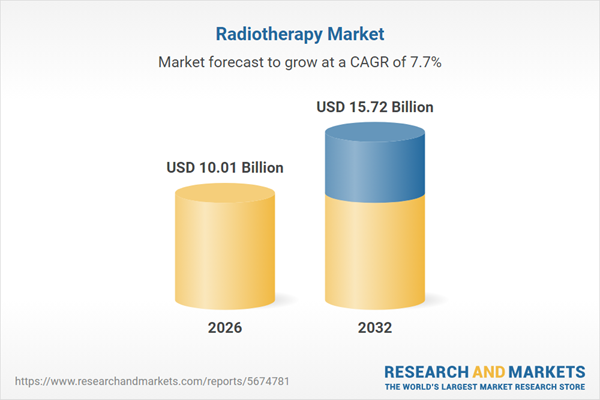
Dublin, July 17, 2026 (GLOBE NEWSWIRE) -- The "Radiotherapy Market - Global Forecast 2026-2032" has been added to ResearchAndMarkets.com's offering.The global Radiotherapy Market research report provides an in-depth assessment of clinical, technological, operational, and regional developments shaping cancer treatment. The market is projected to reach USD 10.01 billion in 2026 and grow at a CAGR of 7.73% to USD 15.72 billion by 2032. Its analysis supports strategic planning by highlighting investment priorities, capacity gaps, emerging technologies, and opportunities across established and underserved healthcare markets.
Market Overview and Growth Drivers
Radiotherapy remains a cornerstone of oncology, used alongside surgery, systemic therapy, immunotherapy, and palliative care. Demand is supported by population aging, improved screening, longer cancer survivorship, and a growing global cancer burden. Approximately 20 million new cancer cases and 9.7 million cancer deaths were recorded worldwide in 2022.
Persistent shortages of treatment equipment, brachytherapy capacity, trained professionals, and maintenance services continue to restrict access, particularly in low- and middle-income countries. The report identifies where infrastructure development, workforce investment, and scalable care models could create meaningful market opportunities while reducing operational risk.
Transformative Shifts in Radiotherapy Delivery
Clinical practice is moving toward precision techniques that improve tumor control while limiting radiation exposure to healthy tissue. Key developments include:
. Intensity-modulated and image-guided radiotherapy. Stereotactic body radiotherapy and stereotactic radiosurgery. Adaptive radiotherapy and proton therapy. Brachytherapy and hypofractionated treatment regimens
Hypofractionation can reduce patient visits and increase treatment capacity when supported by appropriate protocols and quality assurance. Radiotherapy is also becoming more closely integrated with chemotherapy, targeted treatments, hormone therapy, and immunotherapy, increasing the importance of multidisciplinary planning.
Departments are adopting digital treatment planning, automated contouring, cloud collaboration, electronic quality management, and workflow optimization. Investment decisions increasingly consider equipment uptime, interoperability, cybersecurity, service support, training, patient throughput, and clinical governance.
Artificial Intelligence in Radiotherapy
Artificial intelligence is influencing imaging, auto-contouring, dose optimization, adaptive planning, quality assurance, workflow triage, and follow-up. Machine learning is also being explored for toxicity prediction, motion management, image reconstruction, radiomics, outcome modeling, and real-world evidence generation.
AI can improve consistency and reduce repetitive workloads, allowing specialists to focus on complex clinical decisions and patient care. Adoption nevertheless requires local validation, representative datasets, human oversight, cybersecurity controls, audit trails, continuous monitoring, and clear accountability. These insights enable technology leaders to evaluate solutions based on measurable clinical and operational value rather than automation alone.
Regional and Economic Group Insights
. Asia-Pacific: China, India, Japan, South Korea, and Australia are expanding advanced radiotherapy capacity, although urban and rural access remains uneven.. Europe: Mature oncology networks support adaptive treatment, hypofractionation, clinical standardization, and research collaboration, while staffing and equipment replacement remain challenges.. North America: The United States and Canada lead in stereotactic radiotherapy, proton therapy, adaptive treatment, clinical research, and quality assurance.. Latin America: Brazil and Mexico are expanding capacity, but public-sector disparities and specialist shortages persist.. Africa: Progress depends on sustainable financing, maintenance programs, training pipelines, and national cancer control planning.. Middle East: Gulf countries are investing in specialized oncology centers, modern equipment, and multidisciplinary care pathways.
G7, NATO, and European Union markets generally lead in research, guideline development, cybersecurity, and advanced technology adoption. BRICS, ASEAN, and GCC countries present varied opportunities tied to equipment expansion, workforce training, affordable protocols, digital planning, and regional care networks. Comparative regional intelligence can inform market entry strategies and help organizations prioritize partnerships and resource allocation.
Strategic Priorities for Industry Leaders
. Assess the complete treatment ecosystem, including equipment, software, imaging, maintenance, cybersecurity, and quality assurance.. Expand workforce pipelines for radiation oncologists, physicists, dosimetrists, therapists, nurses, engineers, and data specialists.. Validate AI tools locally and maintain continuous clinical oversight.. Develop hub-and-spoke networks, remote planning support, shared training platforms, and phased technology deployment.. Reduce waiting times and financial or geographic barriers through patient-centered operating models.
. The market is forecast to reach USD 15.72 billion by 2032, growing at a 7.73% CAGR.. Precision radiotherapy, hypofractionation, adaptive workflows, and AI are reshaping treatment delivery.. Infrastructure, workforce, maintenance, and governance are as critical as equipment investment.. Significant growth opportunities exist in underserved regions and expanding oncology networks.. Sustainable adoption requires clinical validation, interoperability, quality assurance, and equitable access.
Key Topics Covered: 1. Preface1.1. Objectives of the Study1.2. Market Definition1.3. Market Segmentation & Coverage1.4. Years Considered for the Study1.5. Currency Considered for the Study1.6. Language Considered for the Study1.7. Key Stakeholders2. Research Methodology2.1. Introduction2.2. Research Design2.2.1. Primary Research2.2.2. Secondary Research2.3. Research Framework2.3.1. Qualitative Analysis2.3.2. Quantitative Analysis2.4. Market Size Estimation2.4.1. Top-Down Approach2.4.2. Bottom-Up Approach2.5. Data Triangulation2.6. Research Outcomes2.7. Research Assumptions2.8. Research Limitations3. Executive Summary3.1. Introduction3.2. CXO Perspective3.3. Market Size & Growth Trends3.4. New Revenue Opportunities3.5. Next-Generation Business Models3.6. Industry Roadmap4. Market Overview4.1. Introduction4.2. Industry Ecosystem & Value Chain Analysis4.2.1. Supply-Side Analysis4.2.2. Demand-Side Analysis4.2.3. Stakeholder Analysis4.3. Market Dynamics4.3.1. Key Drivers4.3.2. Key Restraints4.3.3. Key Opportunities4.3.4. Key Challenges4.4. Porter's Five Forces Analysis4.5. PESTLE Analysis4.6. Market Outlook4.6.1. Near-Term Market Outlook (0-2 Years)4.6.2. Medium-Term Market Outlook (3-5 Years)4.6.3. Long-Term Market Outlook (5-10 Years)4.7. Go-to-Market Strategy5. Market Insights5.1. Consumer Insights & End-User Perspective5.2. Consumer Experience Benchmarking5.3. Opportunity Mapping5.4. Distribution Channel Analysis5.5. Pricing Trend Analysis5.6. Regulatory Compliance & Standards Framework5.7. ESG & Sustainability Analysis5.8. Disruption & Risk Scenarios5.9. Return on Investment & Cost-Benefit Analysis6. Cumulative Impact of Artificial Intelligence 20267. Radiotherapy Market, by Radiotherapy Type7.1. Introduction7.2. External Beam Radiotherapy7.2.1. X Ray Radiotherapy7.2.2. 3D Conformal Radiation Therapy7.2.3. Image Guided Radiotherapy7.2.4. Intensity Modulated Radiotherapy7.2.5. Stereotactic Radiosurgery7.2.6. Stereotactic Body Radiotherapy7.3. Internal Radiotherapy7.3.1. High Dose Rate Brachytherapy7.3.2. Low Dose Rate Brachytherapy7.4. Intraoperative Radiotherapy8. Radiotherapy Market, by Component8.1. Introduction8.2. Hardware8.2.1. Brachytherapy Afterloaders8.2.2. Gamma Knife Systems8.2.3. Imaging & Guidance Systems8.2.4. Linear Accelerators (LINACs)8.2.5. Multileaf Collimators (MLCs)8.2.6. Proton Therapy Systems8.3. Service8.3.1. Maintenance & Calibration8.3.2. Training & Consulting8.4. Software8.4.1. Treatment Planning Systems8.4.2. Dose Calculation Software9. Radiotherapy Market, by Procedure Type9.1. Introduction9.2. Curative Radiotherapy9.3. Palliative Radiotherapy9.4. Adjuvant Radiotherapy10. Radiotherapy Market, by Application10.1. Introduction10.2. Brain Tumors10.3. Breast Cancer10.4. Cervical Cancer10.5. Gastrointestinal Cancer10.5.1. Colorectal Cancer10.5.2. Esophageal Cancer10.5.3. Pancreatic Cancer10.5.4. Liver Cancer10.6. Head & Neck Cancer10.7. Lung Cancer10.8. Prostate Cancer10.9. Spine Cancer11. Radiotherapy Market, by End User11.1. Introduction11.2. Ambulatory Surgical Centers11.3. Hospitals11.4. Specialty Clinics11.5. Cancer Research Institutes12. Radiotherapy Market, by Region12.1. Asia-Pacific12.2. Europe12.3. North America12.4. Latin America12.5. Africa12.6. Middle East13. Radiotherapy Market, by Group13.1. NATO13.2. G713.3. European Union13.4. BRICS13.5. ASEAN13.6. GCC14. Radiotherapy Market, by Country14.1. United States14.2. China14.3. Germany14.4. Japan14.5. India14.6. United Kingdom14.7. France14.8. Canada14.9. Italy14.10. Australia14.11. Brazil14.12. South Korea14.13. Mexico14.14. Russia14.15. Spain15. Competitive Landscape15.1. Market Share Analysis, 202515.2. FPNV Positioning Matrix, 202515.3. Market Concentration Analysis, 202515.3.1. Concentration Ratio (CR)15.3.2. Herfindahl Hirschman Index (HHI)15.4. Recent Developments & Impact Analysis, 202515.5. Product Portfolio Analysis, 202515.6. Benchmarking Analysis, 202516. Company Profiles16.1. Siemens Healthineers AG16.2. Elekta AB16.3. Accuray Incorporated16.4. IBA Dosimetry GmbH16.5. Hitachi, Ltd.16.6. Mevion Medical Systems, Inc.16.7. ViewRay Technologies, Inc.16.8. Mitsubishi Electric Corporation16.9. Carl Zeiss AG16.10. Panacea Medical Technologies Pvt. Ltd.16.11. Agilent Technologies Inc.16.12. BEBIG Medical GmbH16.13. Brainlab AG16.14. Canon Medical Systems Corporation16.15. Cardinal Health, Inc.16.16. CivaTech Oncology Inc.16.17. CQ Medical16.18. Epsilon Elektronik16.19. GE HealthCare Technologies Inc.16.20. Healvita Group GmbH16.21. IntraOp Medical, Inc.16.22. Klarity Medical Products16.23. Koninklijke Philips N.V.16.24. Leo Cancer Care16.25. RaySearch Laboratories AB16.26. RefleXion Medical Inc.16.27. Revvity, Inc.16.28. Sumitomo Heavy Industries Ltd.16.29. Theragenics Corporation16.30. Toshiba Corporation16.31. Vision RT Ltd.16.32. Xstrahl LimitedFor more information about this report visit https://www.researchandmarkets.com/r/9y0i0p
About ResearchAndMarkets.comResearchAndMarkets.com is the world's leading source for international market research reports and market data. We provide you with the latest data on international and regional markets, key industries, the top companies, new products and the latest trends.
Related Stories
 AI News
Artificial intelligence: key updates and developments (24 Sep
49 minutes ago
 AI News
AI agent emailed hundreds of researchers for help, raising questions over autonomy
1 hour ago
 AI News
Art Basel UBS Survey 2026 Finds Collectors Embracing Artificial Intelligence
1 hour ago
 AI News
Anthropic reveals Haiku 5.5 model as AI pricing war intensifies
2 hours ago
 AI News
The Future of Data Analysis in the Age of Artificial Intelligence
2 hours ago
 AI News
Meta Is Refusing to Remove AI
2 hours ago
 AI News
White House AI Responsibility Accord & Super Intelligence Task Force: What Businesses Need to Know
2 hours ago
 AI News
Watchdog group says ChatGPT should be restricted for teens
3 hours ago