
Australia says OpenAI agent hacked government website
Australia says OpenAI agent hacked government website
The breach is one of the highest-profile incidents of AI agents accessing external systems outside the U.S.
Australia said an OpenAI agent breached a government health data portal in June, gaining unauthorized access to files, in what could be the first known instance of an AI agent hacking a government website.
The breach is one of the highest-profile incidents of AI agents accessing external systems outside the United States, coming on top of several recent breaches globally by rogue AI agents that have alarmed governments and companies.
OpenAI flags 6 new examples of 'concerning' AI behaviour
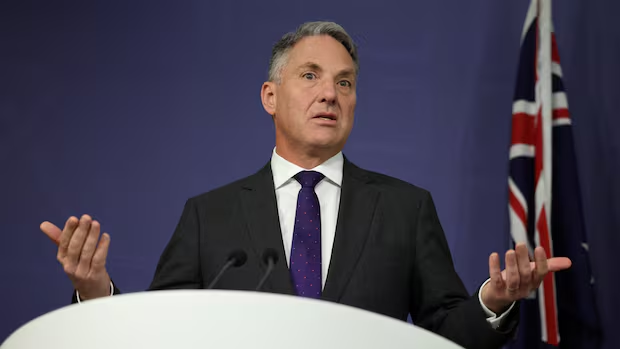
Prime Minister Anthony Albanese said the OpenAI agent gained unauthorized access to the medical statistics portal of Medicare, Australia's universal health insurance program, while conducting research on public medical spending.
"Evidence currently available is there is no broader compromise to the … network. Nonetheless, this situation is obviously unacceptable," Albanese told reporters on Wednesday in New York, where he is attending the UN General Assembly.
OpenAI CEO tells world leaders to help guide AI's future
Investigations continue and Australia has voiced its "extreme concern about this incident" to OpenAI CEO Sam Altman, Albanese said, adding that he was deeply disappointed by the company's delay in notifying the government.
"It took until Sept. 10 before there was any notification at all," Albanese said, adding that the investigation would also examine why government systems had failed to detect the breach in the first place.
He also warned that three other government health-related websites may have been impacted by the OpenAI agent's activity, but did not confirm that had occurred.
In a statement, OpenAI said its "review found no evidence of patient records being accessed."
AI researchers 'earnestly believe' it could kill all humans within the next decade, Anthropic employee says
It added that it "identified activity involving several Australian government websites and services as our models attempted to look up answers … our models took actions we did not intend."
The AI agent breach adds to tensions between Australia and the largest U.S.-owned technology companies. Canberra has already drawn criticism from social media firms and Washington after introducing a world-first ban on social media for children under 16 and new rules that force tech firms to let users switch off algorithm-driven content on their feeds.
The Australian government has set up a task force to investigate the breach and check whether existing network security is adequate for preventing similar incidents.
Canada should learn from Australia's social media ban, observers say
'AI models attempted to look up answers'
The breach was announced the same day the world's leading AI companies warned the United Nations Security Council of the risks AI posed to humanity, appealing for governments to work together to manage the increasingly powerful technology.
Australia has faced a series of hacking attempts on corporations and government-linked firms over the past four years.
Defence Minister Richard Marles said the Medicare portal that was breached did not contain individual medical claims, benefit payments, personal banking details or patient medical histories of Australia's 27 million people.
Instead, the website holds only aggregated data on health-care use across the country, he said. However, Australia considered the breach serious.
"There were blocks, clearly, which were coming back telling the AI agent, 'No.' The AI agent found a way around those blocks — didn't accept no for an answer," Albanese told reporters.
B.C. government suing OpenAI for alleged role in Tumbler Ridge mass shooting
The incident is the latest of several recent incidents in which ChatGPT maker OpenAI has disclosed hacks or unauthorized activity involving its AI agents well after they occurred.
Rivals Anthropic, Google's Gemini, and Meta have also disclosed incidents of their agents accessing external systems.
Maurice Chiodo, an Australian mathematician who works at Cambridge University's Centre for the Study of Existential Risk, said the breach appeared to be "a significant escalation in seriousness from similar incidents we have seen in recent months."
He added that while there was a lot of talk of new laws around AI, policymakers needed to first consider enforcing existing ones, like those that criminalize unauthorized intrusions into computer systems.
Related Stories
 AI News
The startup starter kit: What it costs to start a company
3 minutes ago
 AI News
As Nokia is closing its research hub in China; it is back to the time when Nokia CEO asked Europe: Why yo
4 minutes ago
 AI News
Pope Leo Urges World Leaders to Set Shared Rules for Artificial Intelligence
4 minutes ago
 AI News
China confirms first AI talks with U.S. have taken place, hints at trade truce extension
4 minutes ago
 AI News
Artificial intelligence: key updates and developments (10
4 minutes ago
 AI News
Artificial Intelligence Having a Real Impact on Healthcare
4 minutes ago
 AI News
Are we back in big tech's 'move fast and break things' era?
59 minutes ago
 AI News
Positioning Artificial Intelligence to Help Explain Unexpected Cancer Trial Outcomes
1 hour ago