
Building the Finance Data Foundation for the AI Era
This article is sponsored by Fynapse by Aptitude and was written, edited, and published in alignment with our Emerj sponsored content guidelines. Learn more about our thought leadership and content creation services on our Emerj Media Services page.
Finance functions are being asked to provide forward-looking guidance and near-real-time visibility using systems largely designed to produce and reconcile historical financial results. The tension between those objectives is evident in the financial close process. APQC reports a median close time of 18 days, rising to 35 days among slower-performing organizations, suggesting that many finance teams still spend weeks consolidating and validating information before leadership has a finalized view of performance.
APQC also finds that only 31% of organizations actively use AI in record-to-report processes, while another 39% remain in the early stages of adoption, indicating that many finance organizations are still building the technology foundations needed for scalable automation and real-time insight.
In an April 2026 study of 197 finance executives by the Financial Education & Research Foundation, 81% of respondents cited manual processes as slowing the month-end close, 49% cited system limitations, and 38% cited data quality issues, while 55% named legacy systems as a barrier to transformation.
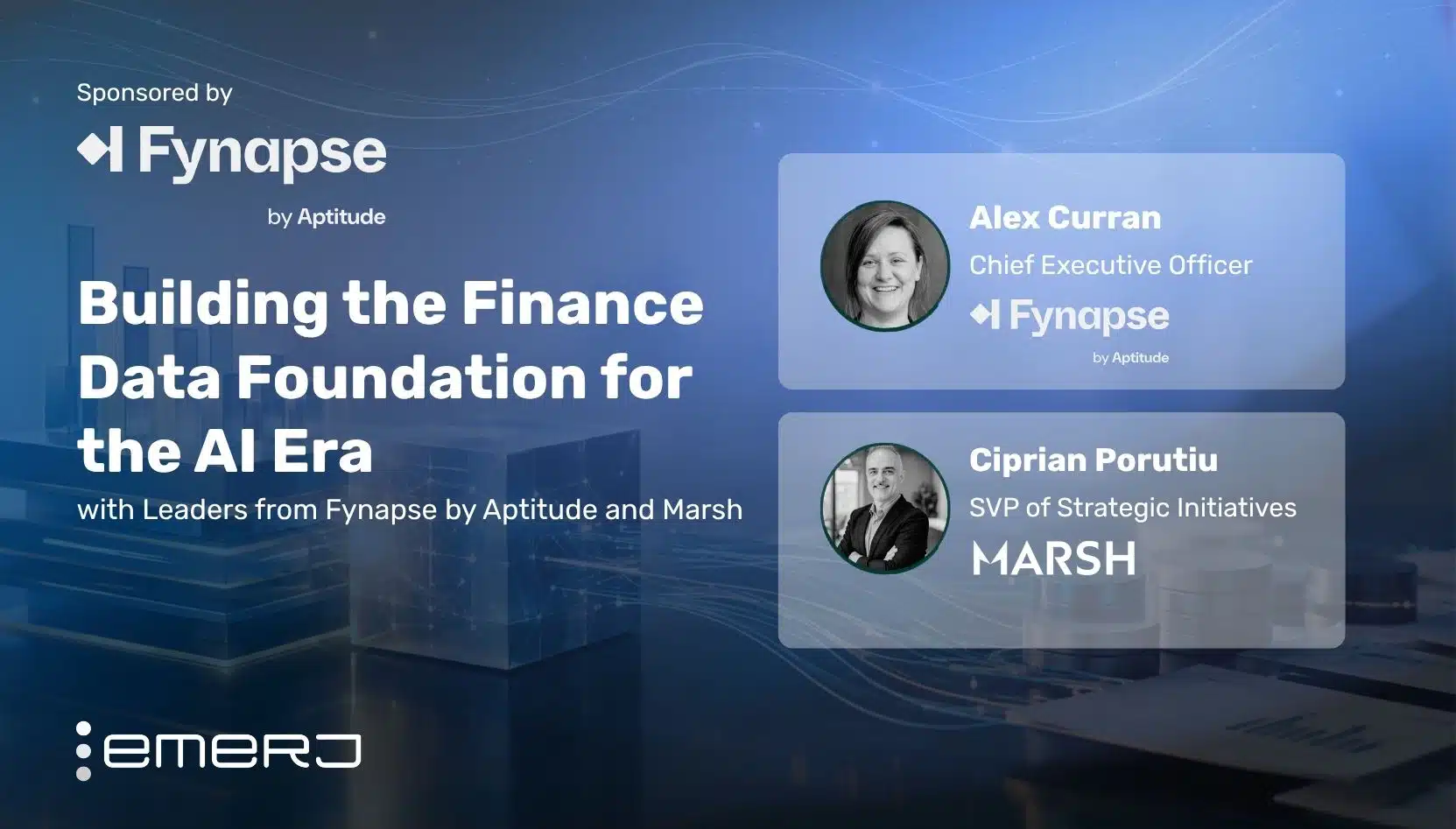
In a two-part series on the AI in Business Podcast, Emerj examines what finance data needs before close, reconciliation, and reporting can run in something close to real time, and before automation and AI can be trusted with any of it. Emerj CEO and Head of Research Daniel Faggella speaks with Alex Curran, Chief Executive Officer at Aptitude Software, and Emerj Senior Editor Yolandi de Weerdt speaks with Ciprian Porutiu, Senior Vice President of Strategic Initiatives at Marsh.
Across both conversations, Curran and Porutiu point to three insights on how finance leaders can prepare their data foundation for automation and AI:
Listen to the full episodes below:
Episode 1: Moving from Delayed Data to Event-Level Visibility – with Alex Curran of Fynapse by Aptitude
Guest: Alex Curran, Chief Executive Officer, Fynapse by Aptitude
Expertise: Finance Modernization, Enterprise Software, Financial Data Management, Accounting and Regulatory Systems
Brief Recognition: Alex Curran is Chief Executive Officer of Aptitude Software Group, the London-headquartered provider of finance data management, accounting, and automation software behind the Fynapse platform. She has spent more than two decades connecting finance systems for large, highly regulated banks, insurers, and telecommunications companies, and built the company’s international business, latterly as Chief Executive Officer for North America, before becoming CEO in 2023.
Episode 2: Modernizing Finance Data for Faster and More Reliable Operations – with Ciprian Porutiu of Marsh
Guest: Ciprian Porutiu, Senior Vice President of Strategic Initiatives at Marsh
Expertise: Business Transformation, Change Management, Operations and Delivery, AI Adoption
Brief Recognition: Ciprian Porutiu is Senior Vice President of Strategic Initiatives, Change Management, and Business Transformation at Marsh, where he leads change inside a multi-entity enterprise through transformation programs spanning finance, CRM, new product launches, and the deployment of AI tools for colleagues and clients. He previously served as the firm’s Vice President of Operations and Delivery for Change Management and Digital Transformation, overseeing governance, continuous improvement, and portfolio management. He holds an MBA in IT Management from Western Governors University.
Capture Financial Events at the Transaction Level
Alex Curran opens the series by arguing that finance’s biggest challenge lies in the expectations placed on it rather than in its data. A decade ago, the job was to report the numbers and make sure they were accurate. Today, she says, finance is expected to explain what happened, predict what happens next, recommend what the business should do about it, and do all three in real time, a shift she has seen sharpen over the past 12 to 18 months:
“The challenge becomes even harder, because they’re expected to do that while operating on the technology platforms that originally have been designed for monthly reporting cycles. That tension is what every CFO I speak to is living with right now. That role has dramatically evolved, but the challenge that they have is that the architecture hasn’t kept up with that.”
— Alex Curran, Chief Executive Officer at Fynapse by Aptitude
That limitation was tolerable, in Curran’s account, while finance was retrospective by design. She is careful to say that AI did not create the weakness; it exposed it. AI and the applications built on it, such as real-time profitability monitoring, continuous reconciliation, and automated checks, depend on timely, governed, transaction-level data.
Curran explains that finance architectures typically aggregate data before it reaches the general ledger. By that point, the detail of each financial event, including the individual transaction, the product, the precise timing, and the exact amount, has already been lost, so any later question about a number has to be answered by reconstructing it.
Curran notes that subscription models, digital transactions, multi-entity structures, and cross-border complexity have multiplied the data flowing into finance, while the underlying architecture was built for a fraction of that volume. When it falls behind, finance teams hire more people, build more spreadsheets, and add more reconciliation layers.
Ciprian Porutiu comes at the same problem from inside a large, multi-entity enterprise and frames it in terms of what finance can and cannot see:
“Everything you see — financial results, revenue, top line or bottom line, efficiency, savings — is the top part of the iceberg. It’s above the waterline. Those are the lagging indicators, the ones everyone discusses in the quarterly reviews and every earnings call. What is underneath is the leading indicators, what creates the context for the lagging indicators to provide not just good results but reliable results.”
— Ciprian Porutiu, Senior Vice President of Strategic Initiatives at Marsh
Curran explains that, in her experience with banks, when a lending product starts losing margin because funding costs have moved, the shift can take six weeks to show up in the management accounts.
With real-time profitability, the same shift surfaces the following morning, while the margin is still recoverable. In insurance, a live P&L can show claims experience deteriorating in a specific segment, so underwriting appetite and pricing are adjusted before the loss ratio compounds.
For Curran, getting there means capturing every financial event at the transaction level and leaving aggregation to reporting, preserving lineage so any number traces back to its originating transaction, and surfacing reconciliation exceptions the moment they occur, so controllers act on differences instead of hunting for them at period end. Her standing question for CFOs captures the shift in the function’s role: when did you last change a business outcome rather than report on one?
Establish a Common Financial Language Before Automating
Everyone in finance is under pressure to move faster, Porutiu acknowledges, but he compares the moment to slowing down on a curve so you can accelerate after it. Automation inherits whatever inconsistencies sit in the data beneath it, so he names four things that have to be in order first: a standardized source of truth, fragmentation resolved, governance, and sequencing. Get those wrong, he warns, and automation simply produces garbage faster.
Fragmentation, Porutiu explains, starts when every line of business and every region builds its own source of truth. One team pulls from the fiduciary system, another from a master record, another from invoicing, and another from spreadsheets and email. This happens even in the largest organizations, and the damage compounds: each manual bridge between systems introduces error, and those errors propagate, so audit controls and rework keep pulling the team back to the beginning.
In insurance, he explains, teams can end up speaking different languages. If revenue means gross written premium to one team and net earned premium to another, or Generally Accepted Accounting Principles (GAAP) to one entity and international standards to the next, the organization cannot report a single number it trusts.
Porutiu lays out the finance value chain in sequence: sub-ledger, transaction processing, reconciliation, then reporting. Reporting is the lagging step, reliable only if everything upstream is in order, which is why he rejects the idea that reporting accuracy can wait.
Standardization, he stresses, does not mean one giant database; in a large enterprise, that is counterproductive. He recommends organizing data into federated domains where ownership stays close to the ground, such as claims data, revenue data, or servicing data. What connects those domains is a shared language:
“What’s an account? What’s an active account? What is a cost center? What are the products? What are the transactions? This is extremely important in order to speak the same language and make those data domains speak to each other. It’s almost more important, the API, than the data itself. If you’re able to connect the various data domains, then you have this triangulation of taxonomy, data dictionary, and data domains working together, and that is a data foundation that allows you to do anything else: automation, reporting, AI, anything you want.”
Porutiu’s sequence for building that common language runs in four steps:
Curran arrives at the same conclusion from the solution provider side, where she sees the cost of fragmentation in the manual effort that never makes it into board presentations. In her experience, source systems, ERPs, consolidation tools, and reporting layers each hold their own version of the truth, and every handoff between them adds risk and latency.
Her rule of thumb is that the organizations moving fastest stopped asking how to replace everything and started asking which single architectural decision makes everything else possible. The answer, she finds, is consistent: begin with the data foundation, holding financial information as books and records in real time, and set wholesale system replacement aside.
Layering AI features onto systems designed for batch, month-end processing may offer short-term relief, Curran cautions, while preserving the limitations of the underlying architecture, what she calls legacy AI. The scrutiny she now sees in evaluations is whether a platform can connect to whatever AI technologies emerge next.
Govern AI Outputs and Phase the Rollout
Curran challenges the assumption that finance modernization requires a multi-year, enterprise-wide replacement. Having watched organizations spend hundreds of millions and wait years to arrive at the same limitations they started with, she urges CFOs to stress-test any solution provider proposing a multi-year rollout.
She names four practical moves that separate mature transitions from stalled ones, and stresses they are not sequential: data readiness, process alignment, governance, and phasing. In her assessment, organizations are typically underinvested in at least two of them. Governance is where she pushes finance leaders hardest, because it is the area most often left until it is too late:
“Who’s going to own the AI-driven outputs? If AI produces a number and it’s wrong, who is accountable? If AI recommends an action and the business takes it, who governs that decision? And when a regulator asks how a particular figure was derived, who can explain it, and how quickly? The hesitation to use AI isn’t around capability; it’s around accountability.”
The CFOs getting ahead of this, she says, treat AI governance as a core finance responsibility: defining the standards, owning the controls, and building the audit trail that makes AI outputs defensible. Because the CFO remains accountable for the integrity of financial reporting, Curran argues that finance should be central to defining the controls for AI-generated financial outputs, working with peers, auditors, and regulators.
Porutiu focuses on the people who have to adopt the new way of working. He sees the gap between a good strategy and the ability to execute it as the point where modernization efforts stall, and his answer is a phased rollout that doubles as a trust exercise.
He advises starting with the lowest-hanging problem, delivering it, and letting the team see value flow from a leading indicator into a lagging one. Then the cross-functional, cross-geography teams who will live with the system come into the design and testing, instead of being presented with a finished tool to learn.
Some people will drift back to old habits, he acknowledges, so he recommends both guardrails and incentives. The guardrail is decommissioning the old path. The incentive is a clear answer to “what’s in it for me” for each role that matters to the change, such as a week of tedious work becoming an hour of meaningful work.
On funding, Porutiu points out that data dictionaries and taxonomies mean nothing to a board, so every phase should be tied to an outcome the C-suite recognizes, such as reporting one trusted number across every region and client segment. Framed as internal cleanup, he says, the work looks like a sunk cost; framed as added value, it gets funded.
For Porutiu, the test of a rollout is what the team says on the day it goes live:
“You bring them in the testing, you bring them in the design, and then by the time it goes live, they’re going to say: this is mine. This is not someone else’s that I have to learn. This is mine. I brought it to life.”
Related Stories
 AI News
From invisible to recomended: How tech startups can win AI search
37 minutes ago
 AI News
Incat Crowther Joins HII on U.S. Navy ROMULUS USVs
38 minutes ago
 AI News
Paul Deegan: Real journalists matter in an AI world
1 hour ago
 AI News
California Enacts Laws Regulating Artificial Intelligence in Employment, Healthcare and Biosecurity
1 hour ago
 AI News
Artificial intelligence: the big bad
1 hour ago
 AI News
Norway seeks temporary ban on smart glasses amid privacy concerns
2 hours ago
 AI News
Cyber, Artificial Intelligence (AI) and Smart Technologies Drive Kenya
2 hours ago
 AI News
Coke and Pepsi conned us into believing litter was our fault. This trick is even worse
2 hours ago