
From invisible to recomended: How tech startups can win AI search
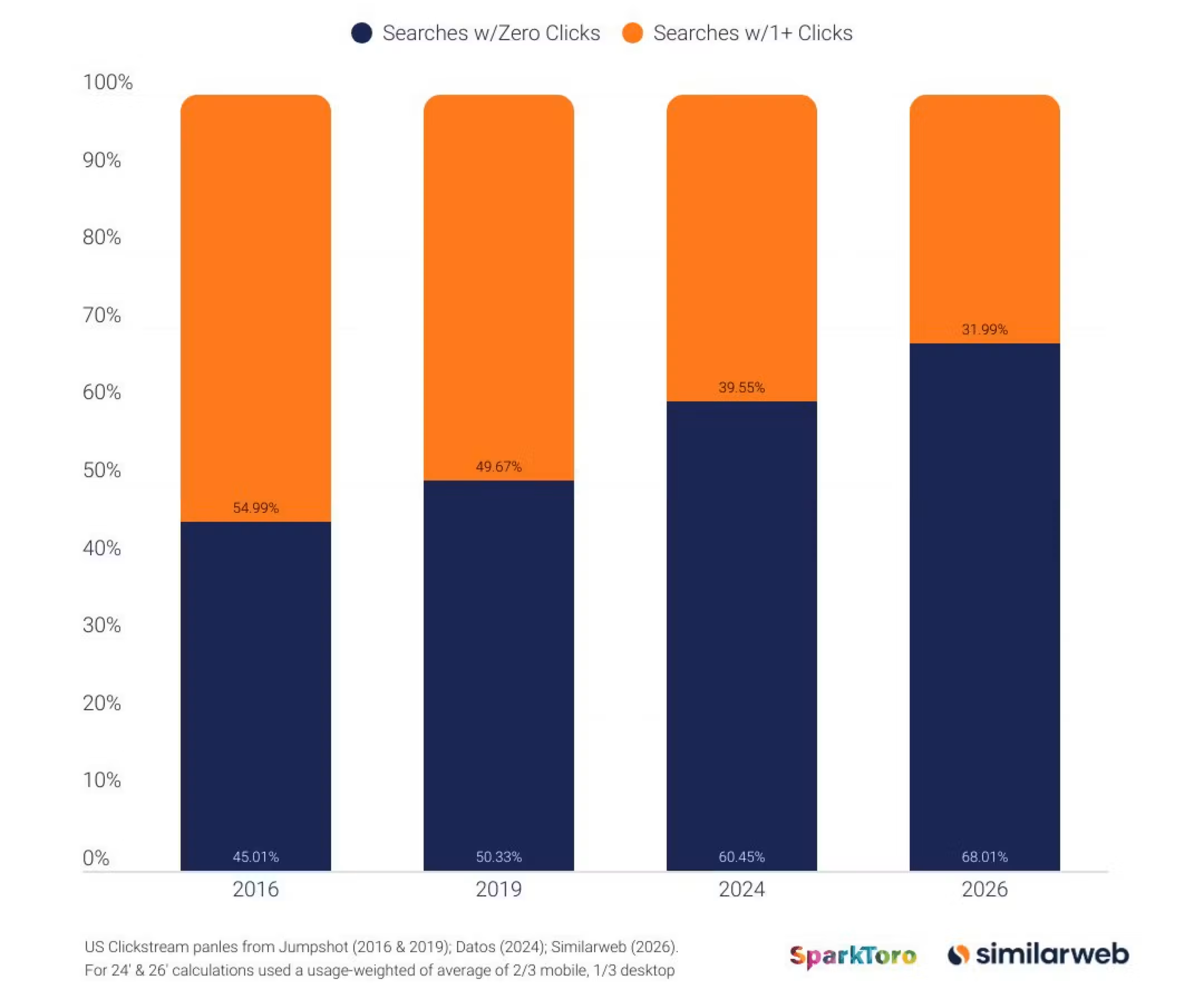
Search no longer ends in a tidy list of blue links. For a large share of queries, the answer resolves before anyone clicks through to a website. According to the Similarweb Zero Click Marketing report, approximately 68% of all Google searches end without an external click to a website, up from about 45% a decade ago.
At the same time, buyers are asking AI systems who to consider. G2’s 2025 Buyer Behaviour report found that AI search-driven leads converted 40% better than traditional search leads, meaning getting in the recommended list is a surefire way to close more clients.
The implication for tech companies is straightforward: if models never name you, category demand still exists.
Why 3rd party coverage is the most important part of AI Visibility
Zero-click behaviour and AI summaries change where attention settles. Discovery is moving into chat interfaces and answer panels that shortlist a handful of names. Publishing more on-page content does not automatically earn a place on those shortlists.
Models lean on language that is clear, repeated, and corroborated across many media sources they can retrieve. Brand-owned pages still matter, but independent coverage, comparisons, and practitioner discussions often carry more weight when an answer is being composed.
Most tech companies are already publishing constantly. Blog posts, LinkedIn, landing pages, the whole machine. Most companies are probably already posting more than enough but not focusing on showing up in the AI search results.
The important question that matters most is:
When a serious buyer asks an AI which companies solve this problem, do you get named or do your competitors?
If you are shipping content every week and still invisible in those answers, the fix is not more posts. It is an operating system for how you earn coverage, citations, and a coherent brand narrative.
Most GEO tools help with on-page work and tracking. Most PR firms help with coverage. Few run both as one system.
Storyline Pros is built around that combination: earned media plus GEO, so high-growth tech companies show up in press and in AI recommendations systematically while also building authority and crediblity with customers and investors alike.
The rest of this piece walks through that process in plain language so founders and marketers can apply the same sequence, whether they run it in-house or with a partner.
The 5 Steps to Getting Recomended by AI
Teams that treat AI visibility as a one-off campaign usually get a spike and then a fade. Teams that treat it as a repeatable system compound. The sequence below is the delivery process Storyline Pros uses with clients. You can run a lighter version yourself. The order matters.
Start by mapping how buyers and models already talk about the space. Which category labels show up in prompts? Which competitors get named together? Which jobs-to-be-done appear as questions rather than brand queries? Sample traditional results and AI answers for the same intents. Note where your product is misfiled, omitted, or collapsed into a rival’s framing.
This is also where you decide what you will not claim. Inconsistent labels across the homepage, PR, and sales materials make it harder for an answer engine to place you. Lock a category sentence you can defend with proof before you pitch or publish.
Use the same messaging across all your on-page, social media, and earned media to create consistency. Choosing the niche you want to own and win is important, especially in very competitive software markets that have a lot of players.
Next, decide where you need to be cited. Inventory the prompt families that matter: category definition, alternatives, comparisons, “best for X,” implementation, and risk. For each family, list the sources models already lean on. Then choose which of those sources you can earn, and which owned pages must become clear enough to absorb that attention.
A useful strategy names target publications, communities, and review destinations, plus the owned pages that should sit behind them: category explainers, comparison pages, methodology notes, and customer proof. Without that map, PR and content drift.
Once category and citation targets are clear, engineer the story people and models will repeat. Narrative engineering turns positioning into short, quotable claims backed by evidence: who you are for, what problem you own, what proof you carry, and what you refuse to be.
A light brand DNA or claim set helps keep every byline and landing page on the same rails. Keep it light. The goal is a coherent public story, not a slogan deck. Models reuse language that recurs across independent sources. Give them language worth reusing.
Most founder's do not have the time or the media training or network to run full media campaigns. If you don't have a big budget focus on getting at least 2 news announcements and work on the on-site work and backlink building as that is nearly free and easy to do.
5. Report what buyers actually see
Rankings and organic sessions still matter, but they miss whether you appear in AI answers for the prompts that start buying journeys. Track prompt coverage, presence versus competitors, citation sources, and whether the public story stays consistent over time.
Pair that with pipeline and conversion quality so you do not optimize for mentions that never become revenue. Great tools like Zerorank AI and OpenSEO connect directly to your Claude or ChatGPT and can keep track of your target prompts and help you take a data driven approach to your GEO efforts.
A practical checklist for the next 90 days
Zero-click search and AI recommendations are already changing how attention and shortlists form. The companies that win this shift will make their brands easy to understand, easy to cite, and easy to verify. Category analysis, AI search strategy, narrative engineering, parallel earned and on-site execution, and honest reporting are what startup founder's need to focus on.
Teams that want this done for them can work with a full-service partner like Storyline Pros. Teams building it themselves usually start with tools like ZeroRank AI or RankPill.
Related Stories
 AI News
Incat Crowther Joins HII on U.S. Navy ROMULUS USVs
38 minutes ago
 AI News
Building the Finance Data Foundation for the AI Era
38 minutes ago
 AI News
Paul Deegan: Real journalists matter in an AI world
1 hour ago
 AI News
California Enacts Laws Regulating Artificial Intelligence in Employment, Healthcare and Biosecurity
1 hour ago
 AI News
Artificial intelligence: the big bad
1 hour ago
 AI News
Norway seeks temporary ban on smart glasses amid privacy concerns
2 hours ago
 AI News
Cyber, Artificial Intelligence (AI) and Smart Technologies Drive Kenya
2 hours ago
 AI News
Coke and Pepsi conned us into believing litter was our fault. This trick is even worse
2 hours ago