
Feeling sticker shock over Canadian beef? Here's why
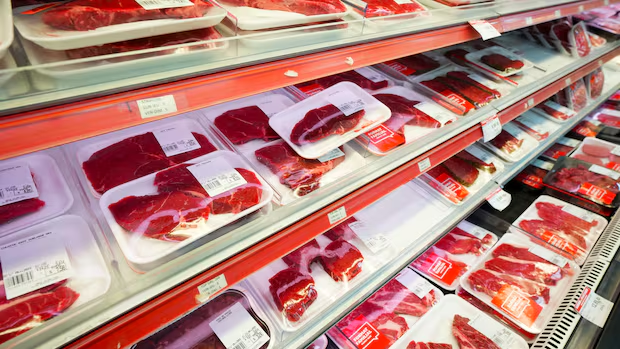
Feeling sticker shock over Canadian beef? Here's why — and what's being done about it
Experts report steep supply-and-demand challenge, interprovincial barriers
If you've stocked up at a grocery store for a barbecue lately, you've probably experienced sticker shock when it comes to the price of beef.
According to Statistics Canada, the price of fresh or frozen beef has gone up almost 13 percent since May of last year. In contrast, fresh or frozen pork and fresh or frozen chicken went up 3 per cent and 1.8 per cent, respectively.
For meat and cattle market analyst Kevin Grier, the ongoing growth defies expectations.
"People keep saying, 'What's the breaking point? When's the breaking going to go? And I don't know, because I've been expecting the breaking point to come for three years," Grier said.
"You could always make an argument that we've reached the limit, but it just seems like we keep going."
So why do beef prices keep rising, and when can Canadians expect relief? CBC's The House spoke to experts across the Canadian meat industry about the issue and the measures the federal government is pitching to address the problem.
Calvin Vaags, president and CEO of True North Foods, a beef processing facility in Manitoba, told The House that the North American supply of cattle is at "historical lows"
Tyler Fulton, a rancher in Manitoba and the president of the Canadian Cattle Association, said ranchers are now in a "rebuilding phase" where they're trying to grow their herds, meaning less beef at the moment for the dinner table.
"The earliest that the product would end up being available to consumers to use would be three years from now," Fulton said. "So it's hard to wrap your head around the economics."
Why meat for your BBQ may cost more this summer
Statistics Canada data shows the size of the overall Canadian cattle herd did rise this January, the first year-over-year increase since 2018.
At the same time, according to a recent market report from Canada Beef, which tracks consumption habits, beef demand last year "is estimated to be the strongest since the early 1980s," fuelled by a surge in demand for protein.
Grilling pains: Why your BBQ may cost more this summer
Vaags said other countries in the world see Canadian beef as an extremely high quality, desirable product to have.
"I think there's other jurisdictions around the world that are willing to pay and keep that price where it is," Vaags said.
Relief from soaring beef prices years away, experts warn
The conditions across Canada right now are "excellent" for raising cattle, Fulton said.
"[There's] no concern over drought, really, with the exception of a small area in B.C.," Fulton said. "Broadly we're actually growing the mother cow herd [and] that is the first point of the whole value chain."
But Brenda Rosadiuk, who raises calves on her ranch in Evansburg, Alta., highlighted some factors that make it harder for her to expand the size of her personal herd.
"We're continually on the phone with the folks we get fuel from, just checking prices," Rosadiuk said. "And fertilizer was so, so high this year."
Beef processing brings an added challenge
Alongside price concerns, the federal government's recently released National Food Security Strategy is taking on the market concentration that leaves the supply chain vulnerable to shocks.
Canadian slaughterhouses, which buy cattle, can be licensed by either provincial or federal food safety bodies.
A provincially licensed slaughterhouse can produce food exclusively for its own province, whereas federally licensed facilities can prepare food across the country and export globally.
Beef prices are soaring. Here's why Canada is facing record-low cattle numbers
But there are only 18 federally inspected cattle slaughterhouses. Three of those are responsible for 85 per cent of Canada's beef processing capacity, and they're operated by two multinational firms, Cargill and JBS Foods.
For Liberal MP Michael Couteau, that's a concern.
"When you have two multinationals controlling beef processing, it doesn't allow for the system to build the resilience necessary and the sovereignty necessary for Canada to be its best," said Coteau, chair of the House of Commons' agriculture committee.
A report from that committee pointed out that while large facilities like the ones operated by Cargill and JBS Foods "offer important economies of scale for production," they leave the supply chain vulnerable to shocks should they falter.
As an example, the report referenced a coronavirus outbreak at Cargill's facility in High River, Alta., which reduced operations to a single shift.
That led to beef producers being unable to bring their cattle to market as planned, creating "a backlog of cattle bound for slaughter and increasing costs for producers whose cattle remain on feedlots for longer than anticipated."
Lewis Robinson, the chef and owner of La Petite Primerose in Gatineau, Que., told The House he sometimes struggles to serve local beef to his customers.
Robinson's restaurant, which focuses on local food, is just across the river from Ottawa. But due to provincial meat slaughtering rules, he can’t bring meat across the Ontario-Quebec border.
"We've worked with [one local farm] that has to drive past Ottawa toward Montreal to get their yak slaughtered so that we can get a hold of it here. They're going an hour and a half out of their way with an animal just to get it processed," Robinson said.
"From what I've discussed with the farmers in this area, they also would like to have more options."
The National Food Security Strategy is pitching $12 million over three years and $3 million ongoing to help some 4,000 provincially-licensed food establishments get hands-on guidance to meet federal food requirements.
Eric Patenaude, who owns Henderson's Meats and Abattoir in Chesterville, Ont., is trying to get federally licensed. He said the process used to be much more demanding, but the federal government has made it easier.
"I've gotten my certification in 30 days," Patenaude said. "That was pretty incredible. So now everything is in the hands of the Canadian Food Inspection Agency, and then we're just moving things along to get the licence."
Patenaude said his goal is to sell meat as far away as Nunavut, and becoming a federally inspected plant allows Quebec farmers to bring their meat to his slaughterhouse.
"We don't want to compete against Cargill. We want our small local farmers, the guys that sell [at] the farmers' market, to be able to sell wherever you want," he said.
In short, it will take time for more slaughterhouses to get federally licensed and for Canadian ranchers to build up their stocks.
Rosadiuk said she wishes could predict a price drop "for everybody's sake." While producers have the opportunity to make more money right now due to higher cattle prices, they still feel the pinch during their own grocery store trips, she said.
"We're consumers like everybody else, right?" Rosadiuk said.
Grier said that although Canadian cattle are slowly rebounding, the U.S. is still experiencing a difficult drought that's impacting its own supply.
"We haven't even hit the bottom yet on the supply side," Grier said. "So it's not gonna get any better…. In terms of the actual demand, since 2015 demand has been rock solid. But [over the] last four or five years, I've never seen anything like it this good."
Despite the high costs right now, Vaags said he hopes Canadians understand the quality of their meat is strong and "still very, very nutritious."
"It's actually cheap compared to, you know, many other places in the world. It's cheap compared to many other things that they're consuming," Vaags said. "And it's very, very intricate and difficult to produce … from the effort and the resources and the time and energy."
Benjamin Lopez Steven is an associate producer for CBC's The House and a digital writer with CBC Politics. He was also a 2024 Joan Donaldson Scholar and a graduate of Carleton University. You can reach him at benjamin.steven@cbc.ca or find him on X at @bensteven_s.
Related Stories
 Canada
'Space Academy': Trump announces new U.S. Space Force school
53 minutes ago
 Canada
Union, industry leaders urge government not to rush trade talks with the U.S.
53 minutes ago
 Canada
Canada
53 minutes ago
 Canada
‘This is our lake’: Canadian brands rally around Lake Ontario with new merchandise
53 minutes ago
 Canada
U.S. civil rights groups make urgent plea for voting rights in D.C., ahead of midterm elections
1 hour ago
 Canada
While Trump targets Canada, U.S. lawmakers decry toll of 6
1 hour ago
 Canada
Interprovincial trade barriers are falling. But rewriting old rules will take time
1 hour ago
 Canada
U.S. may seek win with Mexico in wake of collapsed trade talks with Canada, says ex
1 hour ago