
From academic start-up to multibillion
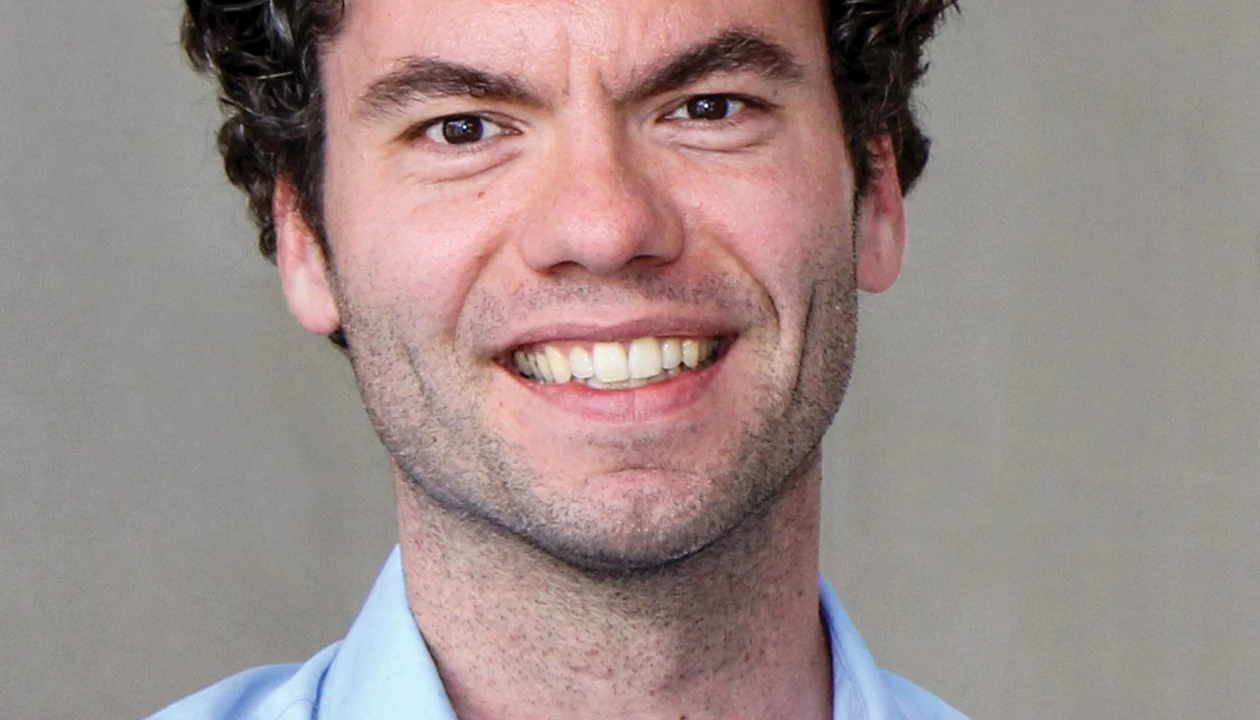
Questions and answers with key voices in the field of chemistry.
Hometown: Born in Osnabrück, Germany; based in Berlin
Education: BS, University of Freiburg; MSc, University of Wisconsin–Madison; PhD, RWTH Aachen University; postdoc, Massachusetts Institute of Technology
Favorite element: Darmstadtium! Just kidding. Of course it is phosphorus.
Hobbies: Modern art, opera, drag culture, singing, running, cats, throwing dinner parties
Christian Hackenberger is a professor of chemical biology at the Leibniz Research Institute for Molecular Pharmacology (FMP) and the Humboldt University of Berlin. He is also the academic cofounder of Tubulis, which launched in 2019 to commercialize antibody-drug conjugates (ADCs)—pharmaceuticals that combine cancer-targeting antibodies with cytotoxic drugs—built with a labeling technology developed in Hackenberger’s lab. In April, Gilead Sciences announced it would acquire Tubulis for $3.15 billion; the deal was finalized on May 21. Hackenberger spoke to C&EN shortly after the deal was announced and discussed the scientific origins of the company, what he thinks is important for an academic cofounder, and what he’s working on now. This interview was edited for length and clarity.
Let’s go back to before Tubulis. Where did the idea for the company come from?
Well, of course it's, as always, a mixture of rational design and serendipitous discovery. Since I started my own lab at the Free University of Berlin in 2005, I was greatly inspired by the bioorthogonal chemistry work from Carolyn Bertozzi and especially phosphorus chemistry, and we had been developing chemoselective Staudinger-phosphite reactions for PEGylating and phosphorylating peptides and proteins. At one point, we stumbled upon a different class of compounds, and these were phosphonites carrying an unsaturated bond. We reacted those phosphorus reagents with azides and all of a sudden generated unsaturated phosphonamidates.
What’s so special about unsaturated phosphonamidates?
These are phosphorus(V) derivatives that carry a triple bond. We thought that they could be interesting electrophiles to react with nucleophiles, especially thiols. We tested them, and they actually worked great. One of the most obvious choices for applying this chemistry was bioconjugation, in particular for the modification of cysteine-containing proteins. From there, it's not a big stretch to also think about ADCs. And it was Marc-André Kasper, who later led the chemistry team at Tubulis, who got this to work during his PhD.
Why was it so obvious that ADCs were a potential application for the P5 conjugation?
We observed very early on that the conjugates that we generated were very stable, especially in the presence of thiols. The obvious alternative for anybody who works on bioconjugation is maleimide chemistry, but the problem with maleimides is that in the presence of other thiol-containing biomolecules, they can undergo a retro-Michael reaction. Thereby, the toxic cargo or payload in an ADC is liberated, which is pretty bad for the targeted delivery of cytotoxic reagents.
We saw that our compounds are far more stable, and they do not get cleaved. Of course this was already great news, but we also discovered that the chemistry to access different unsaturated phosphorus(V) derivatives was very broad. We did not only use the phosphonamidates but also phosphonates, phosphonothiolates, phosphinates, and phosphine oxides. Later, we also were able to increase hydrophilicity in our ADCs by incorporating homogeneous PEG [polyethylene glycol] chains into our reagents, which was very important for hydrophobic drug payloads. In other words, we had a very stable, high-yielding, and hydrophilic but also modular platform technology, which we called P5 labeling.
Having good technology is one thing, but what else did you need before spinning out a company?
We definitely thought that we had something powerful at hand around 2015.
This was a time when ADCs were already known for quite some time, with some already on the market. Still, the field of ADC research always had its ups and downs. Sometimes it was hyped, but then some failed clinical trials lowered the excitement quite a bit.
This was also a time when I had the possibility to coordinate a consortium within Germany focusing on different conjugation technologies to modify proteins. This was a so-called priority program funded by the German Research Foundation. And in this program, I got to know a wonderful colleague, Heinrich Leonhardt from the LMU [Ludwig Maximilian University] Munich, and we realized that we should join forces. Heinrich had a lot of experience in antibody engineering and antibody development, and with our experience in peptide and protein chemistry and synthesis, we realized it would be ideal to actually produce some ADCs and evaluate them.
By a perfect coincidence, Dominik Schumacher joined my lab for his PhD around this time. And Dominik was not only a fantastic chemical biologist, but he also studied business and chemistry. I remember him saying in his interview, “If you have ever something that could be potential for a spin-off, I would love to do this after my PhD.” So he was very excited about [academic-to-industry] translation from the get-go. And then there was an additional coworker from Heinrich Leonhardt's lab, Jonas Helma-Smets, who also had experience with translation. When we saw the really promising results and potency of our ADCs, we started thinking about what would be the next steps in founding a company and raising some money to get more preclinical data.
You said ADCs have gone up and down in fashion. How did that affect your ability to find that first funding?
You are hitting really an interesting point there. Of course, we had great data. We also had great publications. Still, we had to find money to really support the foundation of the company.
In Germany, we are in the luxurious position that there are government programs available in which you can apply for nondilutive start-up money. The program we applied for was one where you get support for some coworkers and research money for up to 2 years. But I should also say that our initial application failed. It was a time when ADC research was not that in vogue, and people were more enthusiastic about immunotherapy. So we continued to obtain even more data, applied in the next round, and then got it. And from there on, we went on looking for new sources of financing and investors, and not just from different foundations.
"If you have a technology that you believe in and that you see a prospect in, go for it. This is your chance."
But to be clear, you are not involved in the day-to-day running of Tubulis.
That's very important to stress here. My lab’s work was a nucleus in the very beginning, but I was not directly involved in Tubulis decision-making. In retrospect, this was probably a pretty smart decision, because I heard several times that investors might become uneasy if the academic cofounder is still strategically involved in every step. As PIs [principal investigators], we are, obviously, in love with our chemistry. So I think it was very important that we as the academic inventors showed that we trusted our people, that we trusted our team, and that we let our technology go. We gave it to the company with all the support possible. This was not the easiest thing, but in the end, it really paid off.
What is your advice for other people interested in translating research out from the lab?
Be prepared to take a risk! I mean, Heinrich Leonhardt and I had our professor positions, so we were pretty much set. The people that took the risk were Dominik and Jonas and all the others who joined this very young company. The other advice I can give is if you have a technology that you believe in and that you see a prospect in, go for it. This is your chance.
This was always something that I admired from the mindset in the US. Especially in the Boston area during my postdoc with Barbara Imperiali, I saw people who wanted to develop new things. And something that they definitely didn't care about is what would happen if they failed. It's about getting experience and seeing if your technology works. And I think this is absolutely the right approach.
That could be seen as perhaps less of a German mindset.
We have awesome biotechs in Germany. Still, a key difference has to do with what I said before about the funding programs. We have a great financial support system to fund different kinds of research from the government, as well as scientific foundations and institutions. But it is sometimes a little bit of a double-edged sword. Although several of such programs are available, they might be too specific for funding a certain endeavor. Maybe your idea is not at the right time for the specific call, and then you have to find another strategy to secure funding.
It can also be difficult to raise interest and support from industry in the beginning, and I often heard, “Well, there are all these wonderful programs available from the government. Why don't you apply for those and then come back later?” In other words, I can see why sometimes people here are a little bit more reserved and try to be a little bit more conservative with their planning. But we are getting a lot better here.
What are you working on now, because your lab has not stood still, right?
Of course not. I mean for sure, we are still using and advancing P5 labeling, but not only for bioconjugation. We recently expanded the P5-labeling platform for more targeted approaches and activity-based protein profiling, for example, to develop probes to target phosphatases or covalent inhibitors. Also, recently we moved into the area of photocatalysis and developed DarT labeling, a metal-free approach for intracellular photocatalytic proximity labeling.
And then another very big area of research in my lab is to think about how to make proteins cell permeable. For example, we have developed the first example of a cell-permeable nanobody that can also functionally reconstitute a CFTR [cystic fibrosis transmembrane conductance regulator] in cystic fibrosis primary cells from patients. We are very excited about this because there are also other very promising antibody formats out there. If we could make them generally cell permeable and come up with a more systemic delivery technology, that would be absolutely brilliant. This is, in my opinion, one of the next frontiers when thinking about pharmacology and biopharmaceuticals. It is something that my lab is working on, so maybe stay tuned for the next translation endeavor there.
Laura Howes is the Executive Editor for life sciences at C&EN.
Related Stories
 Technology
Tech breakthrough: Semiconductors surge, energy struggles
1 week ago
 Technology
VIU technology diploma program returns with strong AI and cybersecurity focus
1 week ago
 Technology
Conservatives blast Liberals for trying to 'ram' controversial lawful access bill through House
1 week ago
 Technology
Oceanscan Offers Dedicated Subsea Calibration Service
1 week ago
 Technology
Sweden's FMV Orders USV for Field Engineering Reconnaissance
1 week ago
 Technology
CaseWorthy Announces Strategic Growth Investment from Rubicon Technology Partners
1 week ago
 Technology
How satellite technology is changing the wildfire insurance response
1 week ago
Texas Tech climbs in latest U.S. News & World Report rankings
1 week ago