
Highway 2 construction ramps up as contract deadline looms
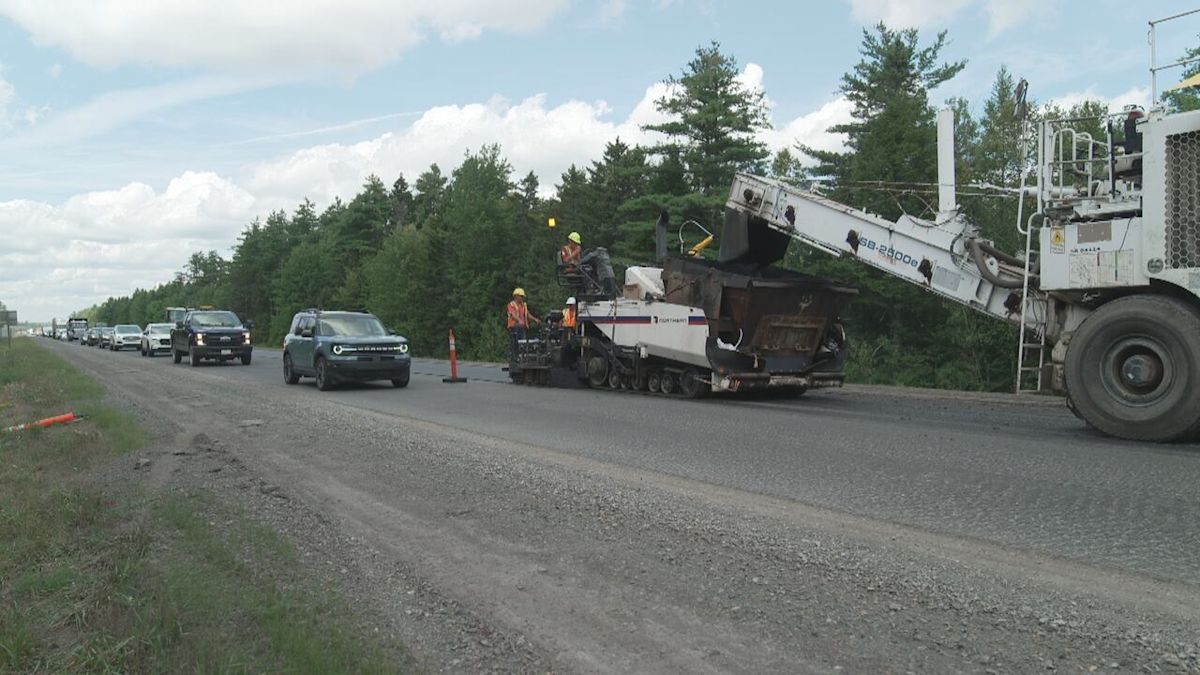
Outside Oromocto, cars and trucks on the Trans-Canada Highway slow down, merge into a single lane and make their way through a canyon of orange traffic cones separating traffic from the machines laying new asphalt.
Driving among pylons has been a common experience for several years on Highway 2 between Fredericton and Moncton.
Nearly 195 kilometres of asphalt is being resurfaced as the contract with the private company that maintains the highway nears its end.
This has spurred a roadwork blitz as the Maritime Road Development Corp., known as MRDC, prepares to hand responsibility for the highway back to the province.
"We've never heard so many compliments about that road and how good of quality it is," Kelly Cain, the deputy minister of transportation and infrastructure, told lawmakers in February.
Construction of the highway from Fredericton to Moncton was one of the first public-private-partnership projects in the country and the first in New Brunswick. (Aniekan Etuhube/CBC)
"They are obligated to have the road surface back and structures back to a certain level before they hand it back to us."
Highway 2 opened to traffic in 2001. Its construction was financed by a 30-year-contract with MRDC that will expire in January 2028.
It was one of the country's first major infrastructure projects to be funded by a public-private partnership, or P3, a model that sees a private company take on responsibility for building a piece of infrastructure and be reimbursed with public funds over time.
Under the original agreement, the province was to pay for maintenance of the highway, and the nearly $600 million cost of construction would be repaid through tolls: $7 for cars and $27.50 for commercial trucks.
The safety of the existing highway, which was old, scenic and undivided, had attracted scrutiny throughout the 1990s because of fatal crashes.
But the Liberal government of the day felt a new highway would be too expensive and take too long to complete if financed by the provincial treasury.
"We're going to have this highway built within four years, open, functional, available and saving lives," Frank McKenna, the premier at the time, said when the highway was announced in 1997.
Former premier Frank McKenna announced in 1997 the province would use a public-private partnership to get a new highway built. (CBC)
The eventual contract would play an outsize role in New Brunswick politics at the close of the century and the beginning of the next.
The process to select eligible vendors to bid on the project faced criticism that it would potentially exclude the lowest-cost option or see the contract awarded to a firm connected to a former cabinet minister.
Five companies expressed interest in bidding, but only three were invited to do so.
A consortium of several companies, Maritime Road Development Corp, was ultimately successful, and the government stuck with the decision even after it was revealed that former Liberal leader Doug Young was a financial partner in the corporation.
The decision to recoup the cost of the project through tolls was also controversial.
The opposition Progressive Conservatives, led by Bernard Lord, rode public discontent with the plan to charge tolls to recoup the upfront cost of the project all the way to government benches.
Lord followed through with his election promise to scrap the tolls and the government agreed to pay "shadow tolls" — payments based on estimated traffic on the highway — to MRDC. In 2013, the agreement was amended to replace the volume-based payments with a fixed fee schedule.
The project may have been one of the first major projects in Canada involving public-private partnerships, but the model has become increasingly common.
It was also used for two other major highway expansions in New Brunswick: the twinning of the rest of the Trans-Canada Highway, from Fredericton to Edmundston and the expansion of Route 1 from just south of Salisbury to St Stephen.
"The first P3 that we did was … Fredericton to Moncton," Serge Gagnon, the assistant deputy minister of transportation, told a legislative committee earlier this year.
"It was a bit of a learning experience. We grew from that agreement to the other two agreements, so the second and the third agreement are more robust."
The highway between Fredericton and Moncton officially opened to traffic in October 2001. (CBC)
In that same committee appearance, Cain admitted the relationship between the province and MRDC hasn't always been smooth.
At times, the Department of Transportation felt MRDC was failing to maintain the road to an acceptable standard.
In 2018, a disagreement over how much the province would pay over the final 10 years of the maintenance portion of the contract went to arbitration.
The province felt it should pay MRDC $164.3 million for the final 10 years of the contract. MRDC wanted $438.8 million.
Ultimately, the arbitration panel set the figure at $307.6 million.
MRDC general manager Ed Donelan did not respond to an interview request. Transportation and Infrastructure Minister Chuck Chiasson was not made available for an interview.
The province has already decided it doesn't want to take over maintaining the highway itself and launched a search for a new operator last summer.
For now, New Brunswickers can expect another summer of heavy roadwork before the current contract expires on Jan. 22, 2028, ending a 30-year-chapter of New Brunswick's political history.
Related Stories
 Canada
Disruption until 2028 as new water pipes installed
29 minutes ago
 Canada
Trump announces Russia
1 hour ago
 Canada
Top stories of the week: Remembering Harrison Yoshy, Canada’s grocery rebate, and Stratford mother found
1 hour ago
 Canada
Heart disease found in 5 of 7 open
1 hour ago
 Canada
What Albertans can expect when they go to vote
2 hours ago
 Canada
Family hubs set to launch across borough
2 hours ago
 Canada
Zelenskyy comments on proposed energy truce
2 hours ago
 Canada
'Book brigade' moves 7,400 books by hand to Hintonburg store's new space
3 hours ago