
Manitoba law used to halt Dynacare strike clearly problematic, union says
Manitoba law used to halt Dynacare strike clearly problematic, union says
Province should not be able to intervene in existing essential service agreements: labour professor
A hearing to determine whether Dynacare workers are essential is within the law, but it shouldn't be, their union says.
The Manitoba Labour Board has been hearing arguments on the matter since the independent body ordered hundreds of lab workers at the private company back on the job this month.
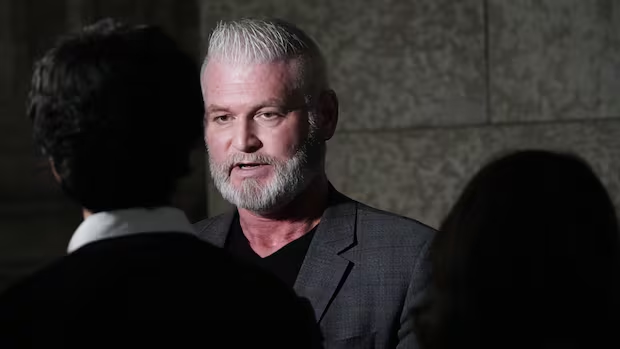
Jason Linklater, president of the Manitoba Association of Health Care Professionals, says that while the process is lawful under current legislation, the move potentially breaches Charter rights and ought to be re-examined.
"This is truly the first test of this new legislation, and clearly it's problematic," he said Monday. "The entire labour community should be very concerned, not only that it exists, but that it was used this way. This is really a red flag."
The hearing was called by Labour Minister Malaya Marcelino based on labour law provisions introduced in 2024 that require employers and workers to determine whether the employees provide essential services, and if so, to reach agreements to continue providing necessary services during a strike.
Dynacare and the union had entered an agreement in March that deemed the workers non-essential.
Shared Health advocated for Dynacare workers to be deemed essential
However, under the legislation, the province's labour minister can intervene at any time if the minister disagrees with the agreement reached by both parties.
Adam King, assistant professor of labour studies at the University of Manitoba, said the intervention stopping the Dynacare strike could have a "chilling effect" on other unions.
"Unions can never be certain [an essential services agreement] is the final word if the minister can just then intervene," King said Wednesday.
"That creates a disincentive to strike or … potentially causes unions and members to be somewhat wary."
David Camfield, a labour studies professor at the University of Manitoba, says the 2024 law presents numerous problems, including giving employers an opportunity to stall during bargaining.
"Employers can come into those discussions with union representatives and put on the table pretty ridiculous claims about who would be considered essential," Camfield said Friday.
Camfield said the "bureaucratic loops" can also throw off a union's timeline for negotiations — as in the Dynacare situation.
The union "went through the process. There was an agreement with the employer," Camfield said. "Just before the strike was about to begin, the government went to the labour board to ask them to intervene, even though the union had done everything by the books."
The province appealed the Dynacare essential worker agreement days after the lab workers overwhelmingly voted in favour of a strike.
Dynacare staff, who have been without a collective agreement since March 31, went on strike on Sept. 8 and were ordered back to work by the labour board later the same day.
Keith LaBossiere, who represented the province in the labour board proceedings, said earlier this month that the policy choices of whatever government are irrelevant to the board's determination of whether the workers are essential.
"Whatever happened, it doesn't deprive the minister from" making the application, LaBossiere said on Sept. 8.
Manitoba Labour Board orders striking Dynacare lab employees back to work
In its final arguments on Tuesday, the province mentioned its legislation is less restrictive than similar laws in British Columbia, where the minister can only intervene to "prevent immediate and serious danger" to health, safety or welfare of residents.
The Manitoba law says essential services must be maintained if needed to "prevent a threat" to health, safety or welfare. The union said in the hearing that a broad interpretation of that definition could set a bad precedent.
King said the language needs to be tightened.
"This broad, unilateral power of the minister to just intervene and ask for reconsideration without providing any new or specific or credible evidence that there actually is a danger, I think, is problematic," he said.
The minister should also be obligated to provide some evidence a review is necessary before the board agrees to an application, King said, and the process should happen within a short time frame, with workers not having to suspend their strike.
The board must make a determination no later than 30 days after receiving an application.
"This is an NDP government doing this. I mean, how would a Conservative government deploy this language, right? We have to think here about different contexts."
Camfield said ideally, the essential services rules would be scrapped altogether.
"On a more modest basis, [at] minimum, would be amendments that would prevent the government from attempting to override an essential service agreement that's been freely reached between the union and the employer," he said.
The NDP's 2024 labour reforms also introduced measures welcomed by labour leaders, including barring the use of replacement workers during a lockout or strike.
Essential service agreements may have been a "trade-off," King said, allowing some employers who would not otherwise be able to hire replacement workers some recourse in case of a stoppage.
But the professor said it's clear the law is a loss for labour.
"I think that a large part of the labour movement was relatively confident that having these essential service agreement requirements in the code wouldn't be problematic because they trusted … the NDP government wouldn't abuse them," he said.
Union suggested Dynacare strike contingency plans could violate rights, labour board hears
Manitoba hospitals don't always have capacity to do their own testing, Dynacare official says
Marcelino did not answer questions about the concerns raised by the labour experts or the union. A spokesperson for the minister repeated the government's position that Dynacare needs to get back to the table and reach a fair deal with workers.
The board said it will deliver a decision by Oct. 1. If it rules Dynacare should be considered an essential service, the employer and the union must then decide what operations must continue during a labour stoppage.
If the parties can't reach a deal, the issue is referred back to the board.
In an email, Dynacare said it's focused on "reaching a fair and sustainable agreement for our employees and the 1.2 million Manitobans who depend on our services every day."
Arturo Chang is a reporter with CBC Manitoba. Before that, he worked for CBC P.E.I. and BNN Bloomberg. You can reach him at arturo.chang@cbc.ca.
Related Stories
 Community
Datacenter developers accused of skirting key US pollution rules
7 hours ago
 Community
Communities share feedback on Yukon’s MMIWG2S+ strategy
11 hours ago
 Community
How policing, social services can respond to wastewater data, drug trends in Saskatchewan
13 hours ago
 Community
Canine conundrum: This N.L. biologist has ideas on what these animals could be
17 hours ago
 Community
‘Refusing to meet Trump was an easy no’: Colin Kaepernick on being ‘blackballed’ for taking the knee, racism, and why he’s still ready to play
23 hours ago
 Community
Sask. celebrates Culture Days for 16th year
1 day ago
 Community
Over $370K raised for 81-year
2 days ago
 Community
Yom Kippur shooting outside Canadian synagogue was 'hate
2 days ago