
Missed the debate? Key takeaways from Quebec party leaders’ final showdown
Missed the debate? Key takeaways from Quebec party leaders’ final showdown
What we heard in the final debate — and what we didn’t — as Oct. 5 vote looms
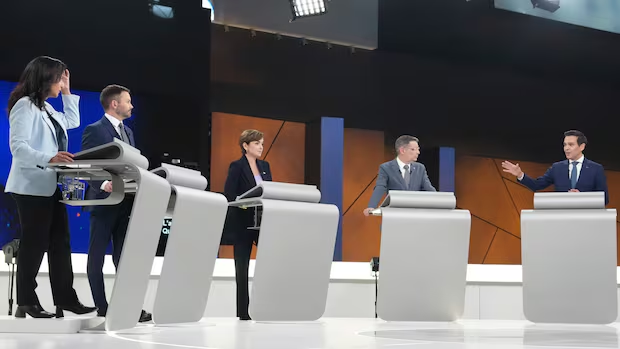
With less than two weeks until Quebec voters head to the polls on Oct. 5, the leaders of Quebec's five main parties faced off over the health-care system, the trade war and the possibility of a referendum.
The third and final debate of this campaign was hosted by Radio-Canada.
While the leaders traded predictable jabs on the economy and immigration, several critical issues— namely Indigenous affairs and climate change— were left off the table.
And although issues pertaining specifically to English-speaking Quebecers were also not discussed during the debate, four of the five party leaders were given a chance to address anglophones while meeting with reporters afterwards.
Here are the key takeaways from Wednesday night.
On a referendum, PQ leader says he's an optimist
With the Parti Québécois (PQ) leading in the polls, the possibility of another referendum on Quebec independence is very real.
But it took more than half the debate for the topic to be raised — when Coalition Avenir Québec (CAQ) Leader Christine Fréchette took a jab at the PQ's leader, Paul St-Pierre Plamondon, as she pumped up her own economic plan.
A little later, St-Pierre Plamondon was asked if he would hold a referendum after Trump leaves office even if the polls suggest the No side will win again. Although he didn't answer directly, he didn't walk back his promise — and stressed he remains an optimist.
"We shouldn't be afraid of democracy," he said, in response to the question. "Jacques Parizeau used to say: 'Don't be afraid of your democracy, of going to the polls, of reflecting on our future.'"
PLQ leader Charles Milliard professes love for ‘great country’ of Canada
Woman's struggle to find doctor sparks exchange
One Montrealer, Tania Lamoureux, asked a question that sparked a heated exchange between the leaders about how to improve access to health care.
The woman said she’s been waiting for years to be assigned a doctor, and asked what concrete plans the leaders have to fix this problem shared by so many Quebecers.
"We still have a lot of work to do. I am very aware of this," Fréchette began, before citing improvements made by her party over the years. Quebec Liberal Party Leader Charles Milliard cut in to say there are still significant waiting times at emergency rooms.
St-Pierre Plamondon said he would eliminate Santé Québec, the newly formed government agency that manages the province's health-care system, to cut down on bureaucracy, while Conservative Party of Quebec Leader Éric Duhaime said he would introduce more privatized care.
Québec Solidaire (QS) co-spokesperson Ruba Ghazal championed more public care. Speaking more generally, she warned that cutting back on the state, as her counterparts propose, could impact services.
Duhaime and Milliard trade accusations around ideology amid discussion on private health care
U.S. President Donald Trump and the trade war, not surprisingly, featured prominently in the debate.
We heard from the parties about how they would best manage the cost of living and Quebec's finances in tumultuous times.
Compare the promises of Quebec’s major parties in the 2026 election
Each tried to make the case they were the person best suited to defend Quebec's interests and protect its economy as Canada negotiates with Washington.
"We won't let you down," said St-Pierre Plamondon, speaking on behalf of the five party leaders. "There is a consensus on supporting you."
St-Pierre Plamondon again said he would cut back the bureaucracy to balance the budget — an ambition shared by the Conservatives.
Ruba Ghazal says Quebec’s hydroelectricity will make the province resistant to Trump’s attacks
Immigration a flash point, again
The topic of immigration generated some fiery debate, with each party outlining its well-entrenched position.
Three out of the five parties want to cut immigration levels compared to last year. The CAQ wants to reduce immigration levels to 45,000, down from 60,000 last year. The Conservatives set the same target, while the PQ would cut that further, to 35,000.
Only QS wants to raise the level of newcomers, targeting 70,000.
The Liberals, meanwhile, still didn't give a clear answer. The party has previously said it would accept anywhere between 45,000 and 70,000 permanent immigrants, depending on integration capacity and workforce needs.
Catch up on all of our live coverage on Thursday's debate
"I am not going to commit tonight," Milliard told reporters after the debate.
The business community has pushed for more immigrants to meet the demands of the labour market.
Paul St-Pierre Plamondon says Quebec needs to reduce its immigration numbers
Beyond the many topics discussed during the debate, two issues were notably absent: Indigenous affairs and the environment.
During the election campaign, the Assembly of First Nations Quebec-Labrador (AFNQL) urged parties to commit to equitable public services, recognize First Nations police services as essential services, and support the revitalization of ancestral languages.
In a recent interview with CBC, Kebaowek First Nation Chief Lance Haymond said it has been "disappointing" that leaders of major parties have passed through his region of Témiscamingue without discussing plans to improve the lives of his constituents.
The leaders, as well, had little to say on the environment. On that front, much of the discussion centred around a proposal by Duhaime to suspend the gas tax. Duhaime took the opportunity to also outline his plan to withdraw Quebec from the cap-and-trade carbon market and eliminate the Electrification and Climate Change Fund, formerly the Fonds vert.
Post debate: leaders address English-speaking Quebec
The English-speaking community also received scant mention during the debate.
Afterward, St-Pierre Plamondon, who had refused an invitation to take part in an English debate, said he was "not closing the door" to taking part in such a debate in the future.
No Quebec English leaders' debate before provincial election as 2 parties decline invite
"Our conception of a country is in full respect of Quebecers whose mother tongue is English, so there's no reason not to talk together or make that change together," the PQ leader said.
Breaking down the key moments in Quebec’s final leaders’ debate
Duhaime once again urged English-speaking Quebecers to "stop being hostages of the Liberals," adding that if they want to hold more political weight as a community, "you need to show that there is some competition going on."
"When there's seats that have been Liberal for two centuries, it's very difficult to attract politicians because the Liberals take you for granted," he said.
Ghazal, whose Québec Solidaire party also seeks Quebec independence, said anglophone rights would be respected if Quebec became an independent country under her party.
"We will always respect their rights," she said.
Fréchette said she would be the premier of all Quebecers and that it is "essential for me to respect the English-speaking community," while highlighting the fact that a CAQ government — unlike the PQ and QS — would not seek a referendum.
Benjamin Shingler is a CBC reporter based in Montreal covering social issues and Quebec politics. He previously worked at The Canadian Press and the New Brunswick Telegraph-Journal, and is an alumnus of the Oxford Climate Journalism Network. He can be reached at benjamin.shingler@cbc.ca.
Related Stories
 Immigration
Immigration Department looking into termination of refugee sponsor policy: Diab
15 hours ago
 Immigration
Minister says immigration increases Canadian prosperity following Trump comments
19 hours ago
 Immigration
Far
1 day ago
 Immigration
Banished to alien lands: Trump’s secret deportation deals
2 days ago
 Immigration
ICE agent shot and wounded man in Austin, Texas, officials say
3 days ago
 Immigration
'Give us a reason to stay', young voters say
3 days ago
 Immigration
Migrant rights rally calls on government to change immigration policy
3 days ago
 Immigration
German Chancellor Merz vows to stay on despite 'disaster' in state election
3 days ago