
The AI Power Divide: Who Controls The Infrastructure Of Intelligence?
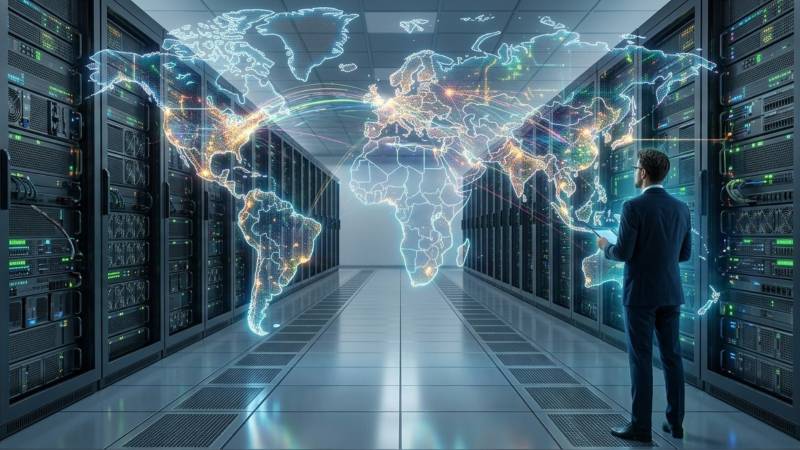
As artificial intelligence becomes embedded in economies and state functions, geopolitical power will increasingly depend not simply on who uses AI, but on who can shape the infrastructure on which intelligence depends. The defining geopolitical fault line of the artificial intelligence era will not be drawn between countries that adopt AI and those that do not. Almost all countries are likely to embrace artificial intelligence in some form. The more consequential divide will be between states that possess meaningful influence over the systems and structures underpinning AI and those that operate largely on terms established elsewhere.
Artificial intelligence is often framed as a competition to produce smarter models, more capable systems and more advanced applications. But the strategic contest is taking place at a deeper level. Beneath the visible race over models lies another struggle: over semiconductors, computing power, cloud infrastructure, data, energy, technical expertise and the rules governing access to them. As AI moves from technological advantage to economic and strategic necessity, control over these foundations is becoming a source of geopolitical leverage. The central question of the AI era is therefore no longer simply who can build the best model. It is who can afford to depend on whom.
The technology contest between the United States and China offers the clearest illustration of what this new politics may look like. Washington has used export controls and technology restrictions to constrain Chinese access to some of the advanced computing capabilities required for frontier AI. Beijing, meanwhile, has accelerated efforts to strengthen domestic semiconductor production, develop alternative technology ecosystems and reduce exposure to external restrictions.
The implications extend far beyond semiconductor manufacturing. An advanced chip can simultaneously function as a commercial product, a strategic asset and an instrument of statecraft. Access to technology can be expanded, restricted or renegotiated as political interests change. That creates a distinctive form of strategic vulnerability. A country may have millions of AI users, a thriving software industry and significant technical expertise while still remaining dependent on foreign chips, cloud platforms, foundational models or critical digital infrastructure.
Adoption does not equal sovereignty. That distinction will increasingly separate states that merely participate in the AI economy from those capable of influencing the conditions under which they participate.
Artificial intelligence was once imagined as almost disembodied software moving through a borderless digital world. It has become intensely physical. Frontier models require advanced chips. Chips depend on complex international supply chains. Data centres require electricity, capital, land, cooling systems and network connectivity. The geography of energy and infrastructure has therefore become an increasingly important determinant of digital power.
The most consequential risk of the AI age may not be that machines become more intelligent than humans, but that humans become increasingly reluctant to exercise judgment when machines appear faster, more precise and more efficient.
The Gulf has recognised this opportunity. Saudi Arabia and the United Arab Emirates are investing heavily in AI infrastructure, advanced computing, data centres and international technology partnerships. Their combination of capital, energy availability, infrastructure and strategic geography creates the possibility of becoming more than consumers of artificial intelligence. For decades, Gulf geopolitical importance rested heavily on hydrocarbons. AI creates another possibility: that part of the region's existing advantage in energy and capital can be converted into computational influence.
That does not mean compute is simply “the new oil.” The analogy is too simplistic. Computing capacity can be constructed, expanded and relocated in ways petroleum reserves cannot. But both reveal the same strategic principle: infrastructure becomes geopolitical when other actors cannot easily function without access to it. This is why the geography of AI may ultimately matter almost as much as the intelligence of AI itself.
Pakistan enters this competition from a fundamentally different position. It cannot realistically compete with the United States or China across the entire AI technology stack, nor can it reproduce the investment scale of the wealthiest Gulf states. But that does not mean its only alternative is technological dependence. The more realistic objective is strategic agency.
For Pakistan, the central question is not whether it can build everything itself. It cannot and neither can most states. The more important question is whether Pakistan wants merely to become an AI-enabled economy, or whether it intends to develop the foundations of an AI-capable state.
The distinction matters. An AI-enabled economy can use artificial intelligence to improve productivity, automate services and create new industries. An AI-capable state understands where its technological dependencies lie and retains enough expertise, infrastructure and alternatives to manage them. Can it avoid becoming permanently locked into a single technological ecosystem? Can it protect strategically sensitive national data? Can it maintain access to critical computing infrastructure during geopolitical disruption? Can its engineers understand and adapt the systems on which public institutions increasingly depend? And can its political institutions retain responsibility for decisions of national consequence even when those decisions are increasingly informed by artificial intelligence?
For Pakistan and for many other middle powers — these questions are strategically more important than the number of AI applications they adopt. Complete technological autonomy is neither realistic nor necessary. What matters is preserving meaningful choice.
The emerging hierarchy of influence in the AI era can be usefully understood through three categories. There will be makers — states and companies capable of producing frontier technologies and controlling critical parts of the AI stack. There will be shapers — countries that may not dominate technological development but possess enough capital, infrastructure, talent, regulatory authority, market power or geography to negotiate the terms of their participation. And there will be takers — states that consume systems whose architecture, access and rules are determined largely elsewhere.
Few countries will possess the capacity to become full-spectrum makers. That is not necessarily a problem. A more dangerous position is to become a permanent taker. For middle powers, the more realistic strategic objective should be to become shapers. That requires diversified technology partnerships, investment in domestic expertise, protection of strategically significant data, resilient access to computing capacity and enough regulatory and technical competence to understand what governments and institutions are adopting before critical systems become deeply dependent upon external providers.
The principle is simple: technological dependence is manageable while political interests remain aligned. When interests diverge, dependence becomes leverage. That is the point at which technology policy begins to become foreign policy.
There is, however, another form of dependence that is less visible and potentially more consequential. For years, debates about artificial intelligence focused on whether machines might eventually think like humans. The more urgent political question may be different: Will humans continue to exercise independent judgment once machines can produce recommendations faster, more efficiently and sometimes more accurately than they can?
Artificial intelligence can calculate probabilities. It can identify patterns across volumes of information no individual policymaker could realistically absorb. It can simulate scenarios, rank risks and recommend courses of action. But probability is not responsibility. A machine can calculate the risks and potential benefits of military action, but it cannot legitimately bear political accountability for starting or refusing a war. It can rank threats to the state, but it cannot be held accountable for deciding which risks society should accept. It can identify patterns in social and economic behaviour, but it cannot determine what level of inequality, coercion or sacrifice a political community should consider legitimate.
It can generate answers. It cannot inherit responsibility for the consequences. These are not merely philosophical objections. They are practical questions of political authority.
A state could possess domestic computing infrastructure, protected data and sophisticated AI models and still surrender an important dimension of sovereignty if its policymakers gradually cease to interrogate the systems informing their decisions. Control over infrastructure is therefore only the first layer of sovereignty. The final layer is judgment.
This leads to a deeper question at the centre of the AI era. Who decides when action is preferable to restraint? Who decides which risks are acceptable? Who determines when efficiency should yield to dignity, legitimacy or justice? And who remains accountable when an AI-informed decision produces consequences that no algorithm can politically answer for?
This is not merely a Pakistani question. It is a universal question of sovereignty. For Muslim societies, the concepts of tafakkur and tadabbur offer a distinct intellectual vocabulary through which this dilemma can also be understood. Both emphasise reflection, deliberation and the conscious exercise of human reason. Their relevance in the AI age does not lie in setting human intelligence against technological progress. The point is almost the opposite.
Technology can extend human intelligence. It can process information at a scale beyond ordinary human capacity and improve the quality of decision-making. But extending intelligence is not the same as transferring authority. Intelligence and authority are not the same thing. Who generates a recommendation is one question. Who retains the right — and accepts the responsibility to decide is another.
The most consequential risk of the AI age may therefore not be that machines become more intelligent than humans. It may be that humans become increasingly reluctant to exercise judgment when machines appear faster, more precise and more efficient. The central debate should not simply be framed as human intelligence versus artificial intelligence. The more important distinction is between intelligence and authority.
The geopolitical fault line of the AI era will therefore not be drawn simply between countries that possess artificial intelligence and those that do not. AI will spread. Power will not spread equally with it.
For the United States and China, the competition is already visible in semiconductors, computing capacity, technology standards and supply chains. For Gulf states, artificial intelligence offers an opportunity to transform capital, energy and infrastructure into another form of strategic influence. For Pakistan and other middle powers, the challenge is different: how to embrace international technology partnerships without allowing technological dependence to harden into strategic dependence.
That requires rejecting two misleading assumptions. The first is that sovereignty requires building everything domestically. The second is that access to technology automatically creates power. Neither is true.
Sovereignty in the AI era will not mean technological isolation. It will mean retaining enough domestic capability, diversified partnerships, infrastructure resilience and institutional knowledge to preserve meaningful choice when geopolitical circumstances change. And it will require something more difficult still: retaining human and institutional authority over decisions whose growing technical complexity makes delegation increasingly tempting.
The industrial age made energy infrastructure a source of national power. The digital age did the same with information. Artificial intelligence is beginning to combine the two. The states that navigate this transition most successfully will not necessarily be those that build every model or manufacture every chip. They will be those that understand where their dependencies begin, where their leverage lies and which decisions they are unwilling to surrender.
And that leaves the world with a question far more consequential than whether machines will eventually learn to think like humans: When intelligence itself becomes infrastructure, who retains the power to decide?
Related Stories
 AI News
Benefits of AI
26 minutes ago
 AI News
RANDOM MUSING: Was the Hugging Face attack Artificial Intelligence's 'Agent Smith breaks free from The Ma
27 minutes ago
 AI News
Europe would not be able to sustain war of attrition with Russia, defence officials say
1 hour ago
 AI News
Helper or shortcut? Central New York families weigh where AI belongs in the classroom
2 hours ago
 AI News
GPT
2 hours ago
 AI News
What Does It Mean to Be Human in age of Artificial Intelligence?
2 hours ago
 AI News
AI
4 hours ago
 AI News
‘We’re plausibly close to crossing the line’: are warnings of uncontrollable AI coming true?
6 hours ago