
N.W.T. organizations work to build bridges between newcomers, Indigenous residents
N.W.T. organizations work to build bridges between newcomers, Indigenous residents
Immigrants 'can play a huge role in making sure that reconciliation is actually happening,' says one chief
Dene Elder Paul Andrew says new immigrants to the N.W.T. are often shocked to hear about the history of colonization in Canada.
“When they hear about some of the treatments that Indigenous people have gone through since contact, I think they're shocked and surprised and disappointed to some degree,” he said.
Andrew says there are now more opportunities for newcomers to learn about Indigenous history and culture, and the ongoing conversations about reconciliation, than there were in the past.
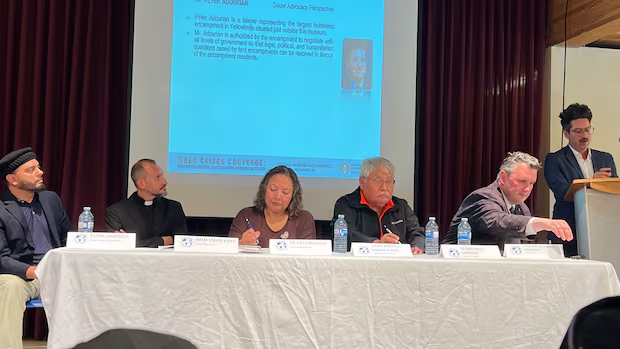
Last weekend, Andrew was the guest of honour at the "Voices for Peace" conference, an annual event held by the Ahmadiyya Muslim Community in Yellowknife. The event brought together religious leaders, Indigenous leaders and community members to discuss regional challenges including climate change, addictions and homelessness.
Andrew said that along with more cross-culture discussion, he wants to see more initiatives that allow newcomers to experience Indigenous culture firsthand.
“The most important thing our elders always tell us is, ‘don't talk about hunting, go hunting,’” he said. “That's the thing I think that we need to get into right now.”
Reconciliation a collective responsibility
Beyond offering historical context, these sort of cross-cultural events can help recent immigrants connect with Indigenous people and understand deeper discussions surrounding Indigenous rights, land and self-determination, Andrew said.
That includes conversations about reserves, the United Nations Declaration on the Rights of Indigenous Peoples as the framework for reconciliation, and efforts toward self-government.
“Because there are more comprehensive claims [in the North], they need to understand what does that mean,” he said. “What does self-government and land claims mean?”
Behchokǫ̀ Chief Bertha Rabesca Zoe also spoke at the weekend conference, and focused on challenges facing her community. She also reminded attendees of the upcoming National Day for Truth and Reconciliation, on Sept. 30.
Speaking with CBC News after the conference, Rabesca Zoe said that reconciliation efforts are a Canadian responsibility and “isn't specific to any race or any ethnic group.”
“Whether you're a new immigrant or somebody that has been here for generations, regardless, I think just as citizens of Canada, especially those that aren't Indigenous, can play a huge role in making sure that reconciliation is actually happening,” she said.
Rabesca Zoe added that she is encouraged to see many newcomers more aware of Indigenous histories. She also highlighted recent progress in policy and legislation.
“We need to keep that momentum up and going,” she said. "So if we educate especially newcomers about those things, so that they understand the importance of reconciliation and the importance of collaboration and why Indigenous people hold the treaties so sacred to their heart.”
The non-profit Northwest Territories Integration and Community Services has also been working to help build cross-cultural relationships with newcomers to the territory. That's involved a series of "Bridging Cultures" talks co-hosted by the volunteer group.
“One of the outcomes of this [event] is actually trying to integrate the newcomers to learn the Indigenous cultures and how they can interact within the community in a way that would be favourable or suitable,” said Eric Neba, who's with the group.
Neba said that his team has invited Indigenous organizations and elders to help facilitate some of the conversation. He says newcomers who have participated in on-the-land programs have expressed interest in further cultural learning.
Neba said participants in these events are discovering shared values between immigrant and Indigenous cultures and traditions.
“Respect for elders is one, respect for your environment and living in a community in a mutual manner is another one,” he said.
Paul Andrew, who is also one of the founders of We Always Remember (WAR), a local group dedicated to recognizing the legacy of residential schools and supporting other survivors in sharing their stories, agreed, saying that he has found many similarities between immigrants he has talked to and his own experiences.
“We have a lot of commonalities with them [newcomers], and I think that is the first thing to recognize,” he said.
Andrew said upcoming events to mark the National Day for Truth and Reconciliation will give new immigrants more chances to learn about Indigenous history, and hopefully spark more conversation.
Yumna Iftikhar is a Pakistani Canadian journalist covering the impact of federal policies on minority communities. She also writes about climate change and Canada’s energy transition journey. Yumna holds a Master of Journalism from Carleton University. She can be reached at yumna.iftikhar1@cbc.ca
Related Stories
 Community
Canadian TV personality restores, then donates rental property to charity
2 hours ago
 Community
Wife of wounded Belleville police officer says he faces 'long, difficult road'
10 hours ago
 Community
Delays in Covid shots for kids is latest bid by Trump officials to restrict vaccines
16 hours ago
 Community
B.C. Premier David Eby to speak as speculation mounts about snap election
1 day ago
 Community
Man wielding shotgun opened fire at officer outside Belleville synagogue: SIU
2 days ago
 Community
'Bang! Bang! Bang!': Witnesses recount confusion, gunshots during Belleville synagogue shooting
2 days ago
 Community
'Two years without Sunday trains is appalling'
3 days ago
 Community
'Children as young as 12 smoking cannabis'
3 days ago